
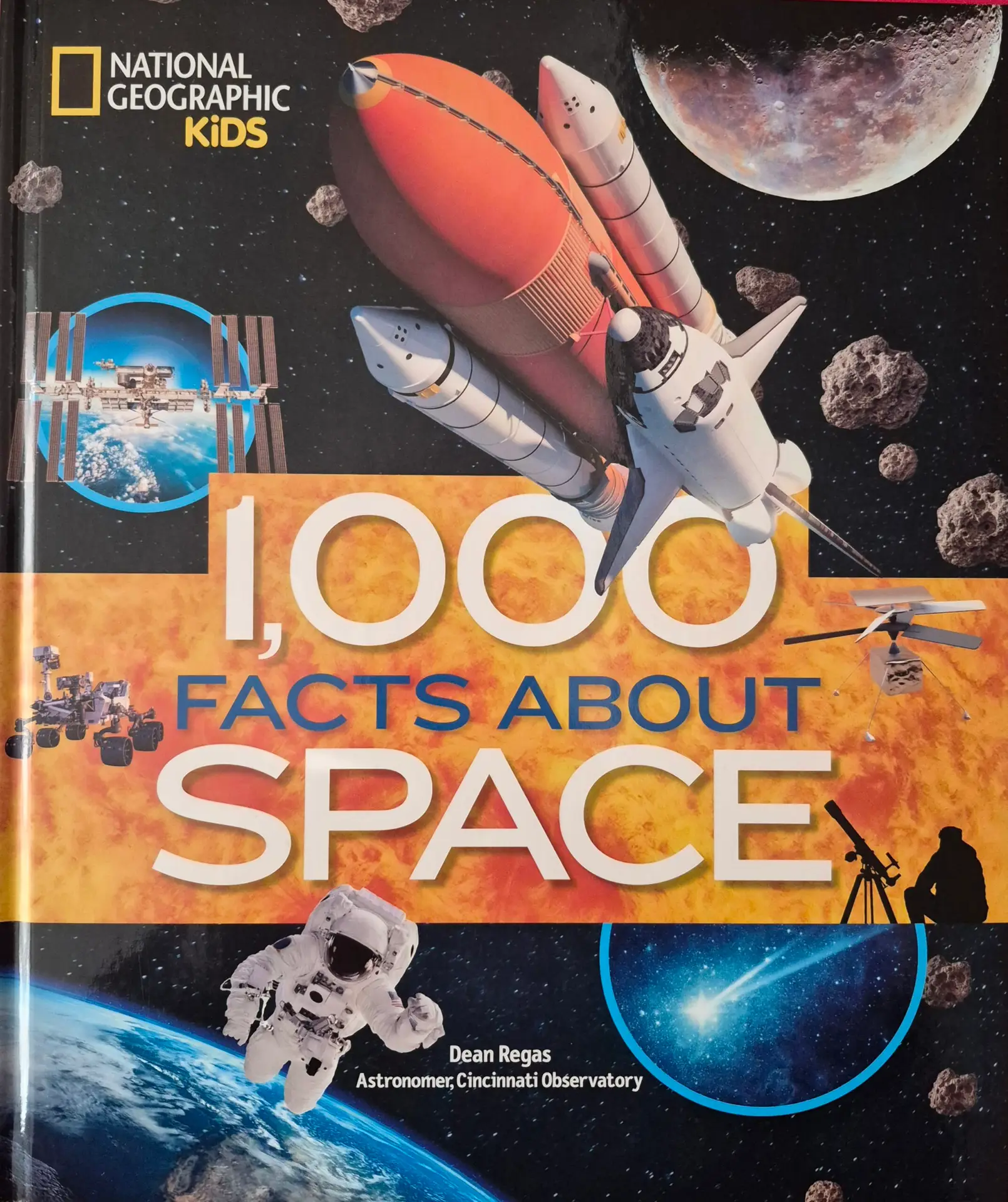

- Title: 1000 Facts About Space
- Author: Dean Regas
- Genre/Subject: Astronomy
- Publisher: National Geographic
- Publication Date: 2022
- Start date: 1/19/26
- Finish date: 1/21/26
Review:
I always say that if you want to learn about something, anything, the best way to do that is to get yourself a kids book. And once again I am proven right as this book was brilliant. Lots of information, lots of pictures, and presented in such a way as to keep me reaching for it instead of my phone.
1000 facts, but it doesn’t start at number 1 and just keep busting them out until you hit the 1K Mark. Rather it is broken up in discrete sections such as 50 facts about the moon, 25 facts about space missions, 50 facts about the sun, and so on.
Sputnik was the size of a beach ball. In my head I always had it sized like a small car, reasoning that computers in 1957 were room sized contraptions and figured the world’s first artificial satellite would be no exception. Once it was in orbit people all over the world would not look for it, but rather listen to it on their shortwave radios. That is so cool and I have no idea why I find it so.
And then there’s the Galilean moons around Jupiter. We have not found life on any planet in the solar system but these icy moons look like a decent possibility. Not necessarily Europan moon space whales cavorting under the ice, but more likely some bacteria similar to ones we find here in extreme environments.
I can talk about this stuff now because I learned some facts and then looked up some of the things that I found particularly interesting. So with the Galilean moons for example I found a podcast with an interview of the scientists who launched a mission to explore them. And I found out all about Mercury from a lot larger book all about the planets. Did you know it has no moons? And it is NOT the hottest planet, counterintuitively that honor goes to Venus with it’s steamy greenhouse atmosphere.
So this is a great book, but I did find one thing that was very distracting and completely unnecessary. “On average Saturn’s rings are only 100 feet (30 m) thick.” Why the fuck do you list the old timey ancient measurement first, when every single country on the face of the globe uses metric? Like if the one country that is too stupid to know that water freezes at 0 and boils at 100 can’t understand what a meter is, they can look it up on Fox News. Even if you want to appease the retards you should put the metric first, but that would be against their freedumbs.
Outside of that this was a great read and I learned so much. I always like to point out that I know about as much as one period at the end of the Encyclopedia Britannica compared to the entire 27 volumes. Meaning I’m always learning and always growing in knowledge and books like this make that an easy and fun process.
This book made me want to: Look to the stars!
Overall rating: 
Readability:
Plot:
Other: Thinking that I might name my next cat Galileo.