
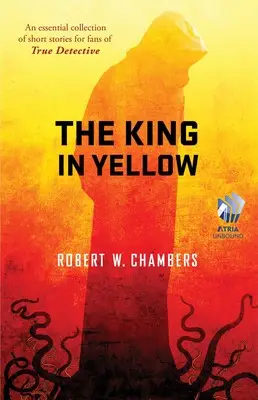

- Title: The King in Yellow
- Author: R.W. Chambers
- Genre/Subject: Gothic Horror
- Publisher: Ibis Press
- Publication Date: 1895
- Start date: 4/2/26
- Finish date: 4/7/26
Review:
I picked this book at random from my bookshelf, always a good way to get out of any reading ruts we tend to fall into. So, how to describe this. First published in 1895, The King in Yellow is a work of weird fiction and horror. First off let me say weird fiction is an actual sub-genre, not just me calling it weird. While it is a collection of short stories, only the first four tales are weird horror which are linked by a forbidden, fictional play called The King in Yellow. The conceit is that reading this play is said to induce madness and despair in anyone who reads it. I think there was a movie once that featured a VHS tape that did the same, and the idea of a cursed book is nothing very new, but Chambers’ treatment of it in this collection is well balanced and skillful.
Chambers blends elements of Gothic horror with the Decadent movement of the late 19th century, which readers of this blog will recognize as one of my enthusiasms. The recurring motifs—the “Yellow Sign,” the sinister city of Carcosa, and the mysterious “Pallid Mask”—serve as symbols of an inescapable, otherworldly corruption. The prose is atmospheric and eerie, often blurring the lines between reality and hallucination, which is a fancy way of saying I had to flip back and forth to figure out what was actually happening.
The collection is divided into two distinct halves. The first half focuses on supernatural horror and the lingering effects of the cursed play. These were great. The second half shifts toward more traditional Parisian bohemian sketches and romantic stories. These were not as great. While the latter half is lighter in tone, the initial horror stories are the Lord of the Rings, while the last half is the Silmarillion.
Chambers creates a sense of “cosmic wrongness” that feels both ancient and contemporary, like a Balrog if I can continue the LOTR metaphor. I mean you read the story and you feel there’s something wrong, like somehow the narrator is leaving something out. I had never heard of this book but I researched it and found that the book’s mythology has left an indelible mark on modern pop culture, from the Cthulhu Mythos to contemporary television series like True Detective. Who knew? Just like the Lovecraft stories, the horror is subtle, rooted in our ancient fears and the perceived fragility of our human minds.
I mentioned the Decadent movement, and I thought this must be tangentially connected to the movement as I had never heard of it. It was more than just a tangential connection—the book is practically a flagship for the Decadent movement in American literature rather than the British and French movement I am more familiar with. Chambers wrote it while the movement was in full swing, and he leaned heavily into the movement’s obsession with art, artificiality, and decay. He even named one of the supporting characters Mr. Wilde.
The title itself is a massive nod to the Decadent movement itself. In the 1890s, French “decadent” novels were famously sold in yellow paper covers to warn readers of their scandalous, “poisonous” content. By naming his cursed, madness-inducing play The King in Yellow, Chambers was literally labeling his fiction as dangerous, avant-garde art. Chambers spent years as an art student in Paris, right in the heart of the movement. The characters are often painters, sculptors, and musicians who are so devoted to their craft that they lose touch with reality. Like me working on a diorama build.
Also I noticed the sensory excess: The descriptions of the fictional city of Carcosa (with its twin suns and black stars) mirror the Decadent love for “unnatural” beauty and highly stylized imagery.
The Decadent movement was fascinated by the idea that civilization and the human mind were “ripening” toward a state of beautiful rot. Chambers took this literally. In the book, the play doesn’t just shock people; it “infects” their minds, leading to a sophisticated kind of spiritual and mental collapse. Because of this book, “Yellow” became the shorthand for anything “weird” or “morbidly artistic” during that era. If someone called a piece of art “yellow” in 1895, they were calling it edgy and Decadent. Think of how early porn films used to be described as “Blue Movies”. I’m old, I remember that.
My Conclusions
The King in Yellow is described by the book cover as a must-read for fans of classic horror and those interested in the origins of the “weird fiction” genre. Meh, okay I guess. It felt dated, but I enjoyed it. It remains a classic, a haunting exploration of art, insanity, and the unknown connections between the past and the unknowable future. The prose itself is very tight, very good and concise, which after reading Possession was really noticeable and I enjoyed that very much. In 21st century terms I might describe this as “trying too hard” and it doesn’t quite work for me. So its critical acclaim is deserved, but my own acclaim remains more reserved.
This book made me want to: See what a first edition in the yellow cover sells for.
Overall rating: 
Readability:
Plot:
Other: Thinking that I might name my next cat Oscar.