
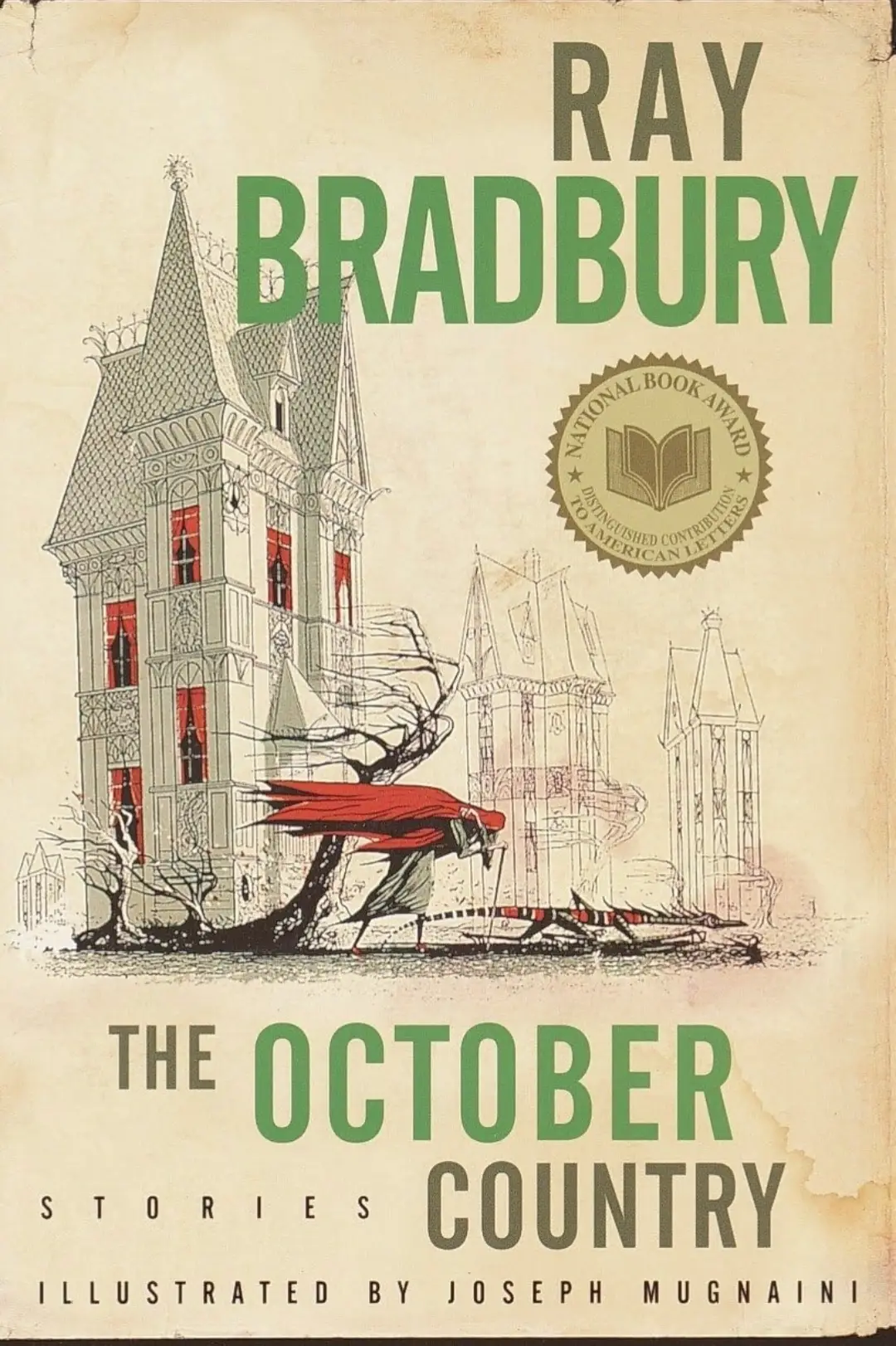

- Title: The October Country
- Author: Ray Bradbury
- Genre/Subject: SF, Horror
- Publisher: Del Rey
- Publication Date: 1975
- Start date: 4/10/26
- Finish date: 4/20/26
Ray Bradbury’s The October Country, first published in 1955, serves as a definitive cornerstone of American gothic and macabre literature. This collection contains nineteen stories, most of which were revised from his earlier work in Dark Carnival. The anthology captures Bradbury’s transition from the visceral pulp horror of the 1940s to the more psychological, poetic prose that defined his later career that I love so much. The epigram, dedication, frontispiece, whatever you call it, says it all and says it so beautifully:
That country where it is always turning late in the year. That country where the hills are fog and the rivers are mist; where noons go quickly , dusks and twilights linger, and midnights stay. That country composed in the main of cellars, sub-cellars, coal bins, closets, attics, and pantries faced away from the sun. That country whose people are autumn people, thinking only autumn thoughts. Whose people passing at night on the empty walks sound like rain…
As soon as I read that, I put a sweater on and switched on the kettle. Call me IshNeil. The collection is the finest and most thematically unified of any of the other Bradbury anthologies I have ever read. Without getting too literary I have identified a few themes (motifs!) that occur throughout the book.
• The Fear of the Physical: Several stories focus on the “betrayal” of the human body. In “The Skeleton,” a man becomes obsessively aware of the bones inside him, viewing them as a parasitic entity.
• The Persistence of the Past: Stories like “The Jar” explore how obsession and nostalgia can manifest into unsettling fixations that disrupt reality.
• Social Isolation and Grief: “The Next in Line” presents a chilling look at mortality and the psychological toll of witnessing the mummified remains in a Mexican catacomb.
• The Transgressed Ordinary: Bradbury finds horror in everyday objects and situations, such as a newborn baby in “The Small Assassin” or a vacuum cleaner in “The Ledge.”
Bradbury’s prose in this collection is characterized by a rhythmic, sensory-heavy style that prioritizes emotional resonance over mechanical plot progression. So no scream movie tropes, but lots of rain, lots of gentle melancholy, lots of memories. Stories include:
“The Scythe”
A farmer discovers he must reap a field to manage the world’s mortality.
“Uncle Einar”
A man with green silken wings struggles to adapt to domestic life. His wife finds him handy for stringing up the laundry on a line to dry.
“Homecoming”
A mortal boy feels alienated within his family of supernatural beings. Imagine being a vampire. Now imagine NOT being a vampire when every person in your family is a vampire.
Historical Significance
The October Country solidified Bradbury’s reputation as a writer capable of elevating genre fiction to the level of high literature. It moved beyond the simple “shred and scream” tactics of early horror magazines like Weird Tales, instead influencing the development of the “quiet horror” movement. The collection remains a seminal influence on contemporary authors of speculative and dark fiction, bridging the gap between Edgar Allan Poe’s gothic tradition and modern psychological thrillers.
I love Ray Bradbury and I loved this collection more than anything I have read from him ever before. And that is not hyperbole, this collection was so satisfying. Checked off all my boxes, appealing to me emotionally, not intellectually and that’s a rare book that can accomplish that. Willa Cather does. Wagner’s operas do as well. So this book is in very good company and I will read and re-read many of these stories over and over again. But…not on sunny days. On days when you switch the lamps on by four, and the shadows grow from a dark noon….
This book made me want to: Stay inside under a dozen blankets while the rain sheets down outside.
Overall rating: 
Readability:
Plot:
Other: The cover art and incidental illustrations are, once again, The Tits.