
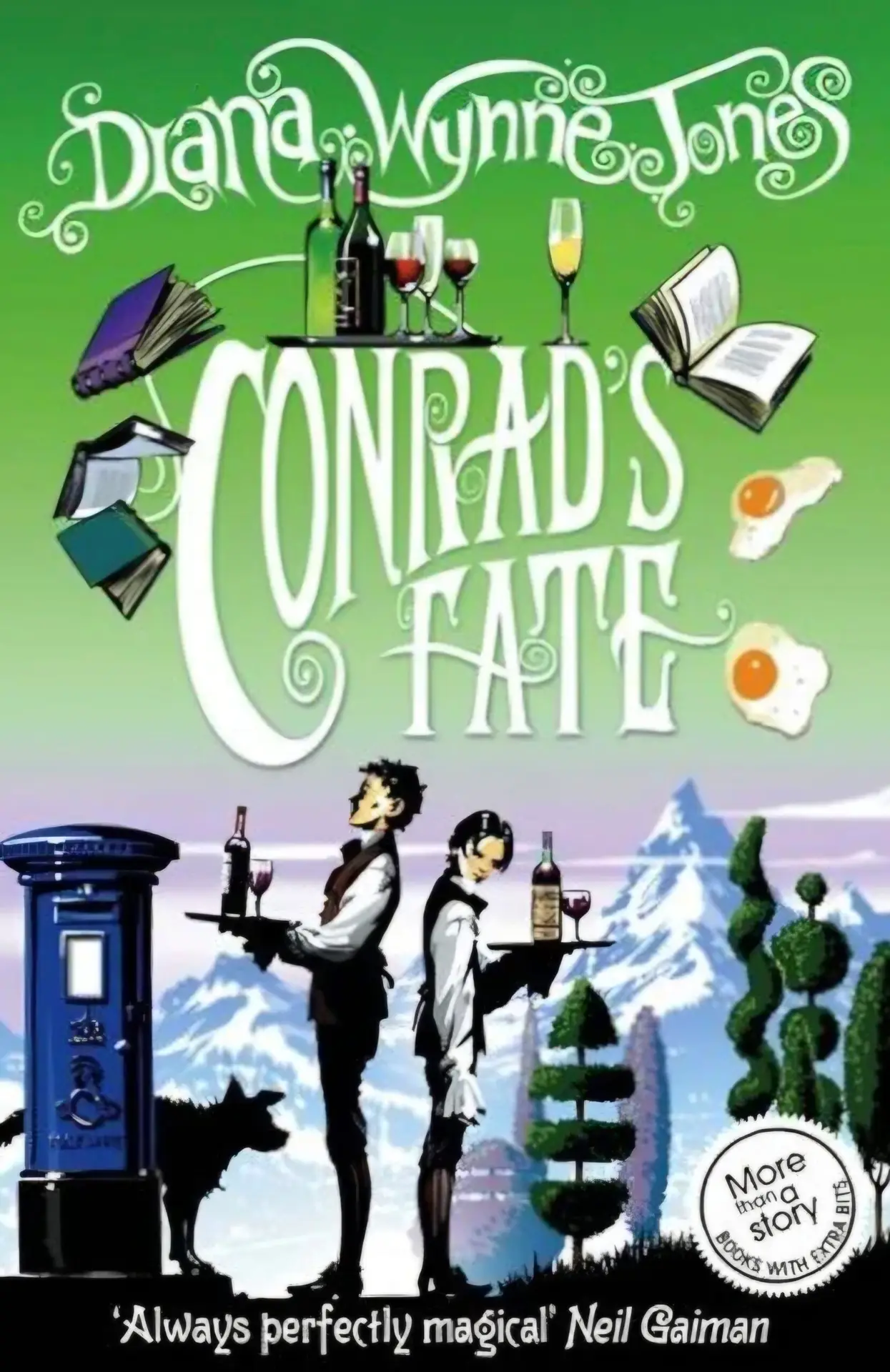

- Title: Conrad’s Fate
- Author: Diana Wynne Jones
- Genre/Subject: Fantasy
- Publisher: Eos Books
- Publication Date: 2005
- Start date: 5/10/26
- Finish date: 5/15/26
Overview and Context
This was, as one editorial review put it, a wild romp! Conrad’s Fate is a young adult fantasy novel by Diana Wynne Jones, published in 2005. It is the fifth chronological novel in the acclaimed Chrestomanci series, though it serves as a prequel to the events of The Magicians of Caprona and Witch Week. I found that out after I finished reading it. However, the novel worked beautifully as a stand alone book, regardless of it being both a sequel and a prequel. In that respect it reminded me of William Gibson’s original Sprawl trilogy, where each novel functioned as a part of the whole but each stood up just as well on their own.
Plot Summary
The story is set in a world parallel to our own where magic is common, specifically within Series Twelve, a world with a distinct Edwardian-era aesthetic and societal structure. The narrative is told from the first-person perspective of twelve-year-old Conrad Tesdinic. Conrad is told by his uncle, Uncle Alfred, that he has a severe pocket of “bad karma” from a past life that will cause him to meet a terrible fate unless he corrects it. To fix this supposed cosmic imbalance, Uncle Alfred sends Conrad to work as a servant at Stallery Mansion, a massive, shifting mansion overlooking the town of Stallchester.
While working under the strict hierarchy of the mansion’s domestic staff, Conrad discovers several anomalies:
The Shifting House: Stallery Mansion constantly alters its dimensions, adding new rooms and corridors because someone is manipulating probabilities to pull wealth and luxury from neighboring parallel worlds.
Christopher Chant: Conrad encounters a fellow servant named “Christopher Twin,” who is actually a teenage Christopher Chant (the future Chrestomanci). Christopher has infiltrated the house undercover to find his missing friend, Millie.
Conrad and Christopher form an uneasy alliance to uncover the source of the probability manipulation. They discover that the masters of the house, “The Family” are exploiting the mansion’s unique position to alter reality for personal gain. In the climax, Conrad realizes that his “bad karma” was a lie manufactured by his uncle to manipulate him into compliance. Together, Christopher and Conrad neutralize the magic, stabilize the mansion, and rescue Millie.
The Upstairs/Downstairs Dynamic
The author utilizes the rigid social structure of Edwardian domestic service to create tension and humor. The strict protocols of footmen, housemaids, and stewards contrast sharply with the chaotic, reality-bending magic occurring behind the scenes. This setting highlights the absurdity of strict class distinctions when the physical world itself is unstable. And I mean actually unstable, as in the characters feel themselves jerked sideways and then have to look for changes, like all post boxes changing to blue from red for example. What they call shifting or changing the possibilities.
Unlike other Chrestomanci books that focus on explicit spellcasting, Conrad’s Fate heavily features this concept of altering probabilities. Stallery Mansion acts as a metaphysical siphon, pulling the “best possible outcomes” from alternate universes, which causes the physical structure of the house to expand irregularly.
Critical Reception and Literary Style
Conrad’s Fate is noted for its tight pacing, humorous take on the Gothic mansion trope, and the chemistry between the pragmatic Conrad and the flamboyant Christopher Chant. “Jones masterfully blends the mundane drudgery of a servant’s life with high-stakes multiversal magic, creating a narrative that is both grounded and extraordinarily imaginative.” was what one editorial reviewer wrote.
Although I didn’t know this, according to the same reviewer: “The novel provides essential backstory for the broader Chrestomanci mythos, particularly regarding Christopher Chant’s transition from an impulsive teenager into a responsible magical authority figure.” Like I said above the novel stood up just fine on its own and not knowing the backstory and, the way things work in this fictional universe didn’t affect my enjoyment one bit. Jones’s signature style—characterized by complex magical systems, multi-layered plotting, and a refusal to condescend to younger readers—is fully on display throughout the text. To the point where I didn’t know it even WAS a young adult novel. Seemed pretty grown-up to me anyhow.
My Conclusions
This was indeed as one reviewer stated, a wild romp. Lots of chasing through attics and cellars, plenty of spells not working as advertised, and just buckets full of good, clean, fun. And that’s a good read if you ask me. Not every fantasy novel has to be the “this is the heir to LOTR!” as so many try desperately to pretend. Magic is not a silly idea but it should not be taken too seriously, or if it is it should at least be tempered with humour like it was in this fun and innovative novel. I doubt that I will pursue the other books in the series, or her other series which consist of a seemingly endless number of sequels and prequels. This was good, and I’ll leave it right here: I enjoyed it and think you will as well.
This book made me want to: Have an adventure!
Overall rating: 
Readability:
Plot:
Other: Model kits mentioned on page 26