
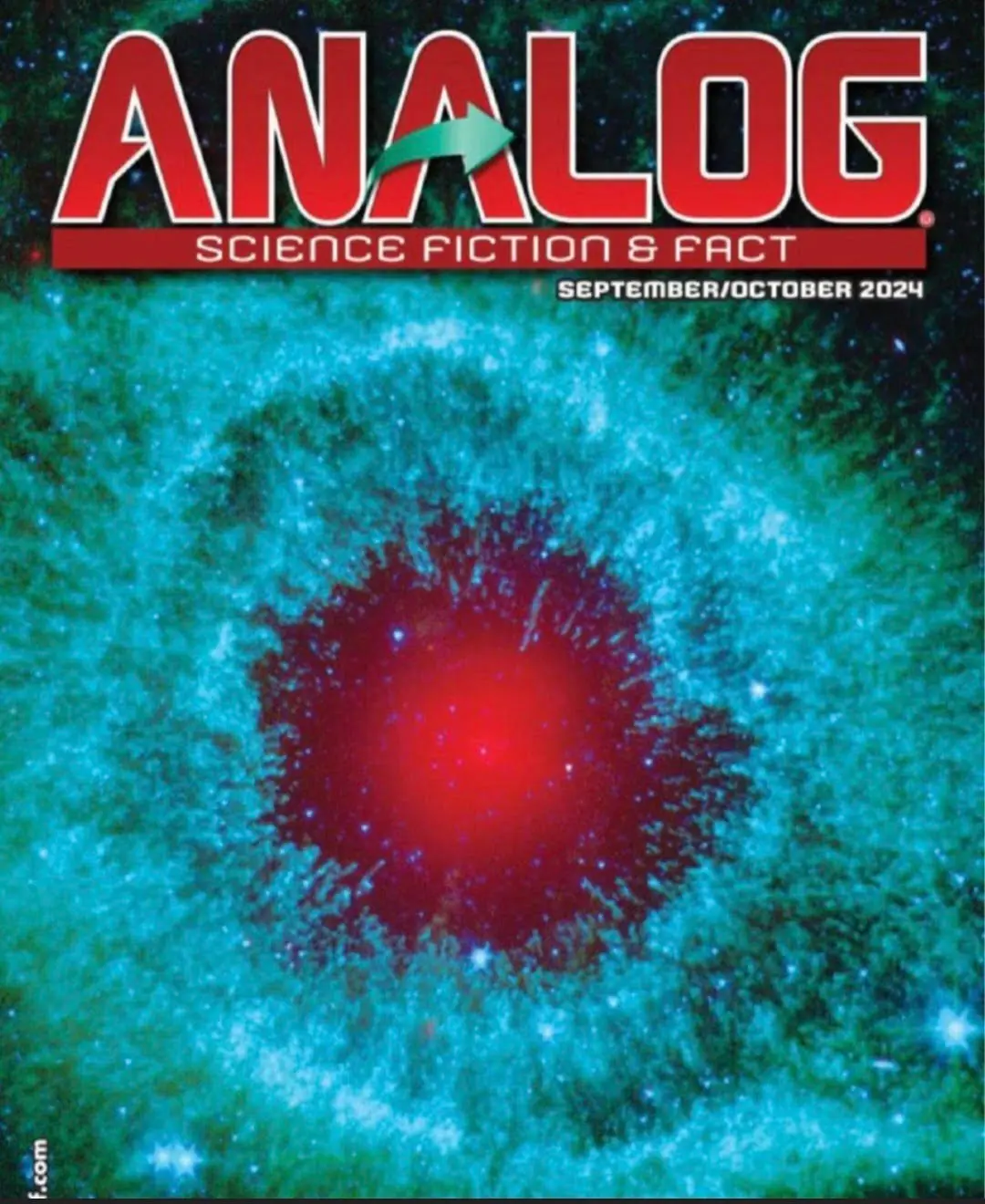

- Title: Analog Science Fiction and Fact Sep/Oct 2024
- Author: Editor Trevor Quachri
- Genre/Subject: Science Fiction, Science Fact
- Publisher: Dell Magazines
- Publication Date: 2024
- Start date: 5/15/26
- Finish date: 5/23/26
From an editorial review: The September/October 2024 issue of Analog Science Fiction and Fact delivers a robust balance of rigorous, hard sci-fi worldbuilding, procedural mysteries, and thoughtful examinations of near-future sociology. Edited by Trevor Quachri, this double issue continues the magazine’s long-standing tradition of grounding speculative concepts in plausible scientific realities while expanding its narrative boundaries.
Could not have said it better myself. Literally, whoever wrote that writes reviews professionally and that really captures what this great magazine, and great issue, is all about. I subscribed to Analog in 2024 and am slowly working my way through all the issues. Each issue is a double-size magazine that works out to artound 200 pages of small print text so it’s a bigger deal than say leafing through the latest issue of Time.
Analog began life with their first issue back in 1930 when they were called Astounding. That’s a long time to be still on the news stands and I can see why, this is a great magazine and this issue features:
Standout Fiction
Novellas and Novelettes
- ”Minnie and Earl Have a Kitten” by Adam-Troy Castro: This installment in Castro’s series continues to follow the bizarre, surreal existence of Minnie and Earl, who appear to be traditional elderly Americans living in a classic ranch house with a white picket fence—except their home rests on the completely uninhabitable surface of the Moon. The story expertly peels back layers of reality, exploring the true nature of the characters with a distinctive mix of charm and eerie alienation.
- “Carter’s Refugio” by Hayden Trenholm: A classic locked-room murder mystery translated into an asteroid setting. The narrative follows Willie Lumen as he investigates the torture and murder of a reclusive asteroid belt trader named Carter. It combines a gritty, noir-style investigation with strict orbital and low-gravity physics.
- “The Compromise” by Tom R. Pike: This narrative dives straight into the complexities of future labor practices, examining the friction and legal compromises between human workers and non-human entities. It stands out for its sharp sociological commentary on corporate governance and labor economics.
Short Stories and Flash Fiction
- “Bad Cop, No Donut” by Ryan Hunke: A lighter, hardboiled procedural following two detectives investigating unregistered “synths” in Philadelphia. While reminiscent of classic Philip K. Dick tropes, Hunke keeps the tone accessible and clever by shifting the primary stakes of the investigation into a local bakery.
- “Imprint” by Zach Poulter: A tense, atmospheric piece featuring an isolated protagonist on an Alaskan highway dealing with a vehicular AI that appears to be broken, malicious, or pursuing an unpredictable sense of vengeance.
- “Carpenter” by Jay Werkheiser: A classic Analog scenario depicting an individual’s technical and tactical battle against unwanted, highly invasive neighbors, emphasizing resourcefulness and practical engineering.
- “The Fyootch” by Wil McCarthy: A satirical and stylistically experimental take on future linguistics, societal drift, and technological acceleration, relying heavily on voice and phonetic prose.
Non-Fiction and Special Features
Science Fact Articles
- “Unfutured Race” by Kelly Lagor: Biologist Kelly Lagor contributes a fascinating overview of how Neanderthals have been depicted throughout the history of science fiction. The piece contrasts early, outdated pulp tropes of primitive cavemen with modern genetic discoveries, showing how speculative fiction has adapted to contemporary evolutionary biology. So what about Unfrozen Caveman Lawyer?
Special Features
- “Finding the Enemy: Did Doc Smith Inspire the CIC?” by Edward M. Wysocki, Jr.: Continuing his historical deep dives into the real-world impact of Astounding (and later Analog) authors, Wysocki investigates whether the space-battle Command Information Centers (CICs) imagined by E.E. “Doc” Smith in his Lensman series directly influenced the development of tactical combat centers used by the US Navy during World War II. I gave it a good effort but couldn’t get through this, it’s great if you want to give it a try. Also, the name Wysocki, an artist with the same name has been one of the most popular to be adapted into jigsaw puzzles and I wonder if there is any relation?
Editorial Excellence and Tone
The poetry and regular departments—including book reviews and the Brass Tacks letters column—round out the issue, maintaining the community-focused feel that keeps the magazine a staple for hard science fiction enthusiasts. Lots of postal addresses for letters, subscription and sales inquiries. I bring that up because it seems anachronistic for a future-looking magazine.
While certain experimental prose styles in the shorter fiction received mixed reactions for breaking the fourth wall or sacrificing character immersion, the overall issue succeeds on the strength of its conceptual ambition. The September/October 2024 issue proves that Analog remains highly capable of adapting classic science fiction archetypes—like asteroid mysteries, AI rebellions, and alien first contacts—into modern, scientifically rigorous narratives.
The September/October 2024 issue of Analog Science Fiction and Fact delivers a robust balance of rigorous, hard sci-fi worldbuilding, procedural mysteries, and thoughtful examinations of near-future sociology. Edited by Trevor Quachri, this double issue continues the magazine’s long-standing tradition of grounding speculative concepts in plausible scientific realities while expanding its narrative boundaries.
This book made me want to: Buy some of the original Astounding pulp magazines.
Overall rating: 
Readability:
Plot:
Other: The size and format are just like the old pulps magazines which is awesome.