
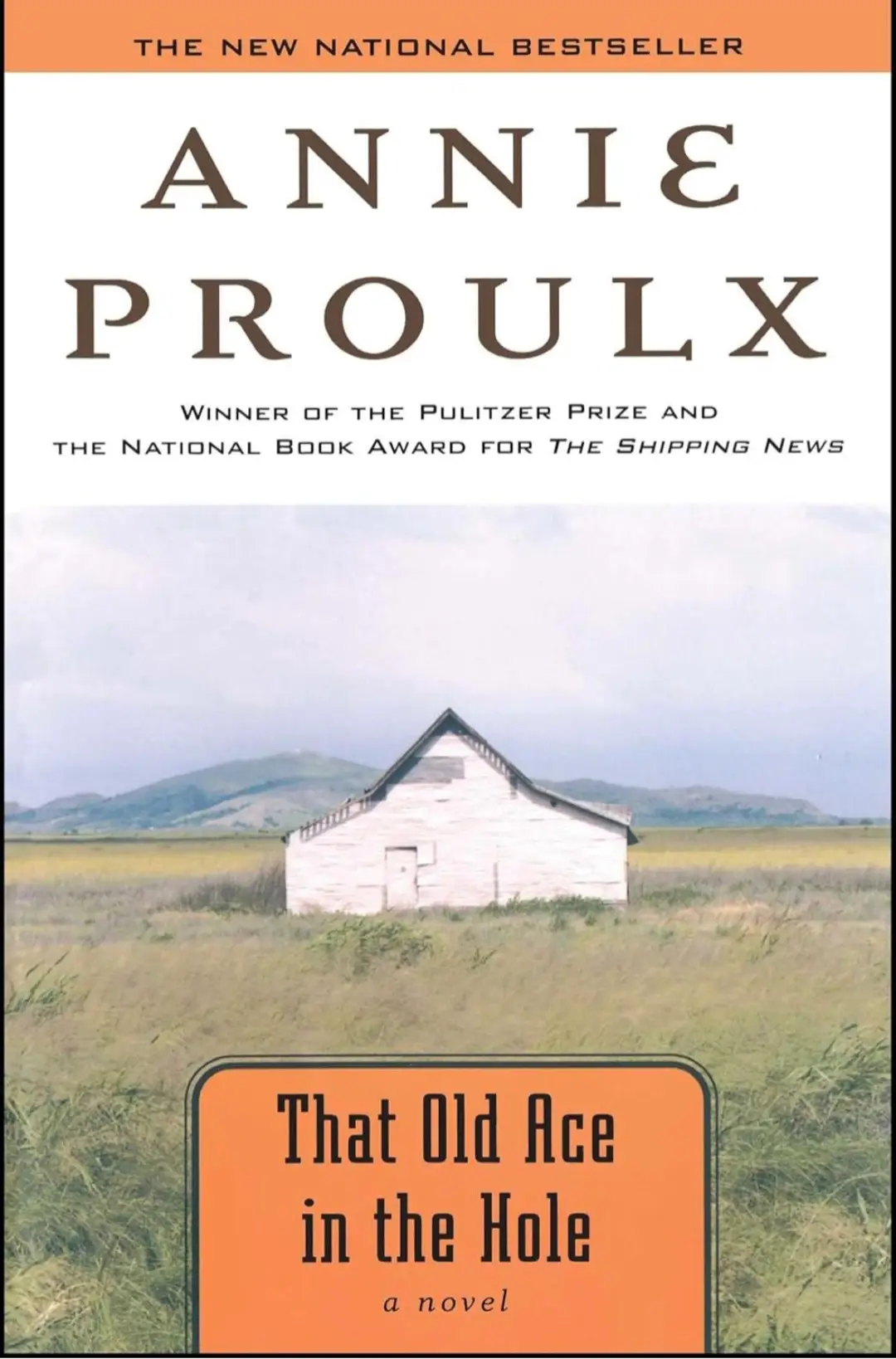

- Title: That Old Ace in the Hole
- Author: Annie Proulx
- Genre/Subject: 21st CenturyAmerican Literature
- Publisher: Scribner
- Publication Date: 2002
- Start date: 6/1/2026
- Finish date: 6/10/2026
Overview
That Old Ace in the Hole (2002) is Annie Proulx’s panoramic, character-driven novel set in the Texas–Oklahoma Panhandle. It follows Bob Dollar, a guileless land scout employed by a corporate hog‑farming conglomerate, as he embeds himself in the fictional town of Woolybucket. Proulx makes the landscape and its people the book’s central subjects: the region’s weather, geology, agricultural infrastructure, ruined oil hopes, and local lore are rendered with the same rigor and relish she brings to dialect and small‑town eccentricities.
Strengths
Sense of place: Proulx’s descriptive powers are superb; the Panhandle becomes a living, often brutal character—vast skies, corrosive winds, irrigated circles, decaying windmills—shaping motive and fate.
Voice and texture: Her ear for dialect, knack for comic grotesque detail, and accumulations of local history give the novel a textured, folkloric feel that feels lovingly researched.
Ensemble cast: A gallery of vividly drawn eccentrics (LaVon Fronk, Ace Crouch, Cy Frease, others) provides moral and emotional counterweights to Bob’s naïveté and creates a communal portrait rather than a single-hero narrative.
Moral ambiguity: The tension between corporate encroachment and local survival is handled with ambiguity; Bob’s gradual sympathy for Woolybucket resists simplistic redemptive closure.
Weaknesses
Plot momentum: The novel favors atmosphere and anecdote over dramatic propulsion; readers expecting a tight, driving plot may find the pacing languid and episodic.
Protagonist passivity: Bob Dollar’s diffident, observational nature can feel underpowered as a force of change; some critics view him as more a receiver of stories than an agent of consequence.
Sentiment and caricature risk: At times Proulx’s affection for regional types pulls toward affectionate stereotype; a few plot elements and character revelations can strike as overlong or schematic.
Themes
The book argues that land, weather, and local memory make ethical and emotional claims on inhabitants—corporate models of efficiency collide with community histories.
Storytelling and history: Much of the novel consists of nested tales, oral histories, and local mythmaking; Proulx uses these to probe how communities narrate survival, shame, and stubbornness.
Modernity vs. tradition: The Global Pork Rind corporation functions as a symbol of extractive modernity whose “progress” threatens ecological and social rhythms—yet Proulx avoids good guys/bad guys portraiture. For the most part. Think of it like Milton’s Paradise Lost where readers for hundreds of years now can’t help but cheer for Lucifer.
Proulx balances deadpan humor, lyrical natural description, and a relish for the grotesque. Her sentences can be lush and exacting; the book rewards readers who savor texture and accumulation more than punchy plot twists.
Conclusions
I really enjoyed this book. That Old Ace in the Hole is a rich novel for readers who value sense of place, folkloric detail, and moral ambiguity over tight plotting. I mentioned my minor quibbles above, because they really are minor. It won’t eclipse Proulx’s best-known triumphs like The Shipping News, Brokeback Mountain, but it stands as a distinctive, compelling portrait of a difficult landscape and the human stubbornness that endures there. A solid four star performance in my considered opinion.
This book made me want to: Eat a lot more biscuits and gravy.
Overall rating: 
Readability:
Plot:
Other: Sending a protagonist to a small town in the Oklahoma panhandle in a fucking Saturn.