
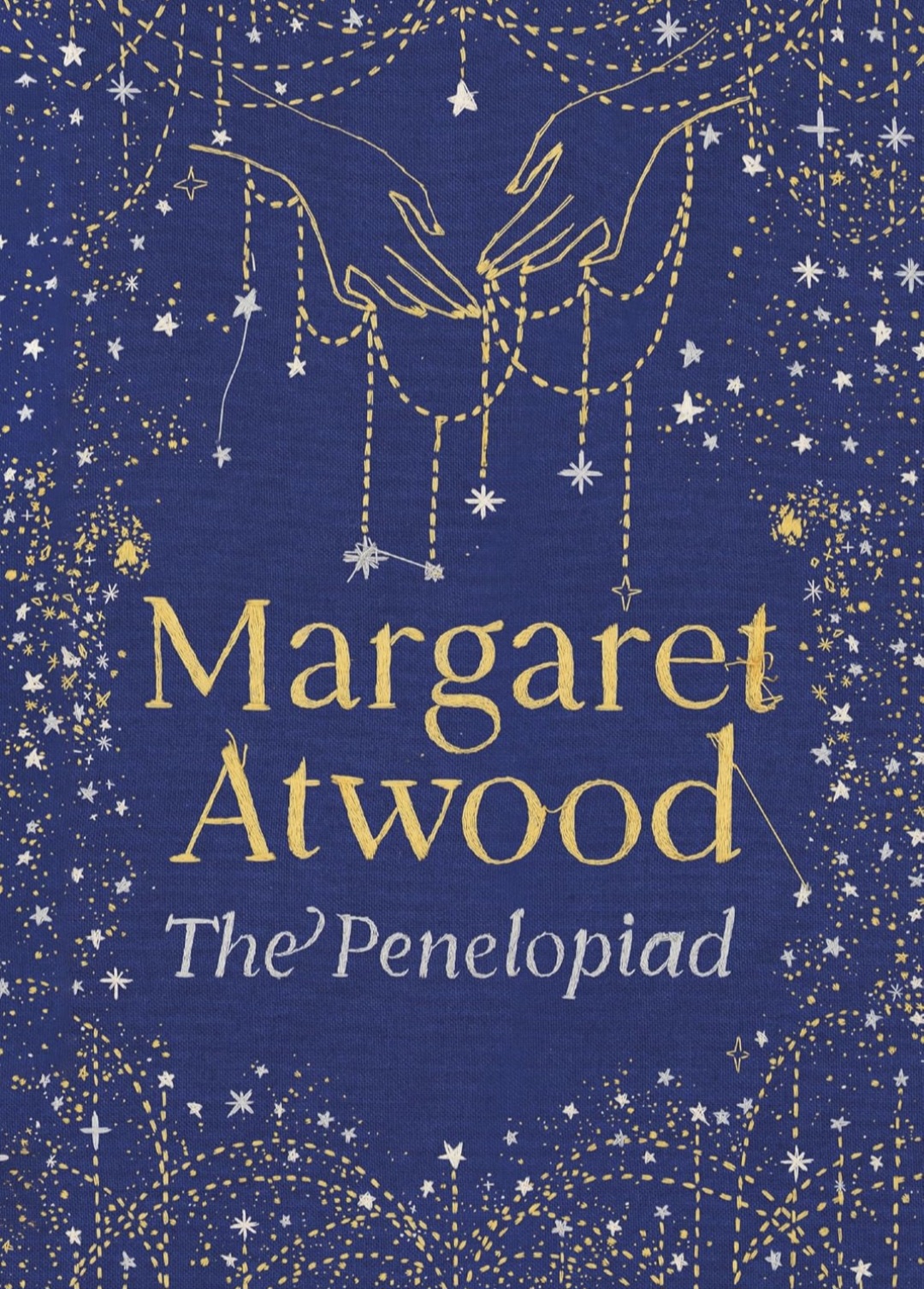

- Title: The Penelopiad
- Author: Margaret Atwood
- Genre/Subject: Mythological Pastiche
- Publisher: Knopf
- Publication Date: 2005
- Start date: 6/7/2026
- Finish date: 6/10/2026
Overview
Overview Margaret Atwood’s The Penelopiad (2005) is a compact, slyly subversive retelling of Homer’s Odyssey that re-centers the narrative on Penelope and the twelve maidservants who are hanged at the end of the original epic. Written as a faux-memoir from Penelope’s vantage in the Underworld, punctuated by a persistent, shape-shifting chorus made up of the maids, the novella reframes mythic events through contemporary, often feminist, concerns about voice, justice, class, and storytelling.
What it does well
Narrative reframing: Atwood gives Penelope agency, irony, and a contemporary sensibility. The first-person confessional voice mixes rueful wit with rueful intelligence, turning a stock Homeric figure into an ambiguous, morally aware narrator.
Chorus technique: The twelve maids serve as a Greek-chorus pastiche and a political device. Their interludes—each in a different form (jump-rope rhyme, lament, ballad, trial, lecture, short drama, etc.)—both diversify tone and foreground classed, gendered silences in the original epic.
Structural cleverness: Alternating prose monologue and poetic/dramatic chorus mirrors classical drama while remaining modern and playful; the book’s brevity sharpens its satirical and elegiac notes.
Thematic clarity: Atwood interrogates double standards (men celebrated for violence and adventure; women punished for sex or survival), the erasure of lower-status women from canonical narratives, and how myths are shaped by those who tell them.
Tone and voice: Penelope’s voice is sardonic but credible; Atwood’s trademark dry humour and melancholy lend the book moral weight without becoming didactic.
Limitations and criticisms
The maids’ anonymity vs. individuality: The chorus’s power comes from collective voice, but some readers and critics feel Atwood doesn’t develop individual maids enough, thereby reproducing a form of erasure even as she critiques it.
Helen and unexamined victimhood: Penelope’s sustained hostility toward Helen is dramatized without fully acknowledging Helen’s own victimhood in many versions of the myth; this choice has been read as a problematic perpetuation of women-on-women blame.
Tonal unevenness: The mix of modern references (Penelope dead in the present, flippant allusions) and archaic material can jolt some readers; a few chapters (notably the mock “anthropology lecture” for some critics) feel less successful stylistically.
Compactness as constraint: The novella’s short form sharpens argument but limits deep psychological or socio-historical excavation; some critics wanted more development of class intersections and the maids’ backstories.
Major themes
Voice and narrative authority: Who gets to tell history? Penelope claims authorship of her story; the maids’ chorus insists on a counter-history.
Gender and double standards: Atwood highlights how sexual agency and victimhood are judged differently across classes and genders—Odysseus’ exploits are heroic; the maids’ coerced relations are criminalized.
Justice and culpability: The hanging of the maids becomes a focal moral puzzle. Atwood complicates culpability—between Odysseus, Telemachus, Penelope, the suitors, and social institutions—rather than offering a single answer.
Performance and genre play: The shifting forms of the chorus underscore how genre shapes reception and moral valence (song softens, trial formalizes, rhyme trivializes).
Memory, afterlife, and revision: Penelope’s vantage from Hades allows retrospective irony and revisionism; Atwood uses afterlife narration to collapse temporal distance and apply present-day scrutiny to myth.
Style
Prose: Plain, colloquial, and deceptively casual; Atwood equips Penelope with urban savvy and wry distance.
Chorus texts: Eclectic—folk forms, theatrical fragments, mock-academic prose—which both pastiche classical forms and modern genres.
Structure: Short chapters, rapid alternation between voices, and epigraph-like framing produce a lithe, theatrical reading experience.
Reception (summary)
Widely praised for inventiveness, wit, and feminist reframing; many reviewers called it a tour de force of concision and moral imagination. Wikipedia
Some critics found the chorus uneven or thinly sketched and argued that certain modernizing gambits (e.g., the lecture chapter) fell flat. Mary Beard praised much of the book but criticized specific sections; other reviewers accused the work of being occasionally indulgent or tonally inconsistent. Wikipedia
The book has been used widely in classrooms as an accessible counterpoint to Homer and as an entry point to discussing narrative authority, gender, and adaptation. diotima-doctafemina.org
Interpretive reading (brief argument) The Penelopiad is less a corrective biography of Penelope than an exploration of storytelling as power. Atwood stages competing narratives—the canonical heroic narrative that sanctifies Odysseus and the counter-narrative of the dispossessed—to show how myth consolidates social hierarchies. The maids’ executions become a moral mirror: by centering their speech, Atwood forces readers to confront how historical narratives excuse elite violence while erasing the suffering of dependents and slaves. The novella’s discomfort—its refusal to provide full exculpation or easy moral closure—is deliberative: it models how revisionist fiction complicates, rather than simply reverses, received myths.
Who will most enjoy it
Readers who like myth retellings with a feminist edge (e.g., contemporary readers of Madeline Miller or Natalie Haynes).
Fans of Atwood’s dry wit and moral intelligence who appreciate concise, formally inventive works.
Teachers and students looking for a short, discussion-rich companion to Homer’s Odyssey.
Bottom line A formally playful, morally urgent novella that reanimates Penelope and makes the muted chorus of the twelve maids audible. Its strengths are voice, structural inventiveness, and thematic sharpness; its limits are the surface-level treatment of some secondary figures and occasional tonal jolts. As a compact act of literary revisionism it is provocative, readable, and thought-provoking—essential for readers interested in how stories shape power.
Further reading suggestions
Homer, The Odyssey (for comparison)
Natalie Haynes, A Thousand Ships (modern myth retelling focused on women)
Selected criticism and classroom guides on The Penelopiad and myth adaptation
This book made me want to: Get some Greek food. I can’t go to Greek restaurants because it would be difficult to avoid alcohol.
Overall rating: 
Readability:
Plot:
Other: No lengthy food descriptions. Looking at you Tolkien, you old Orc-hating gourmand.