
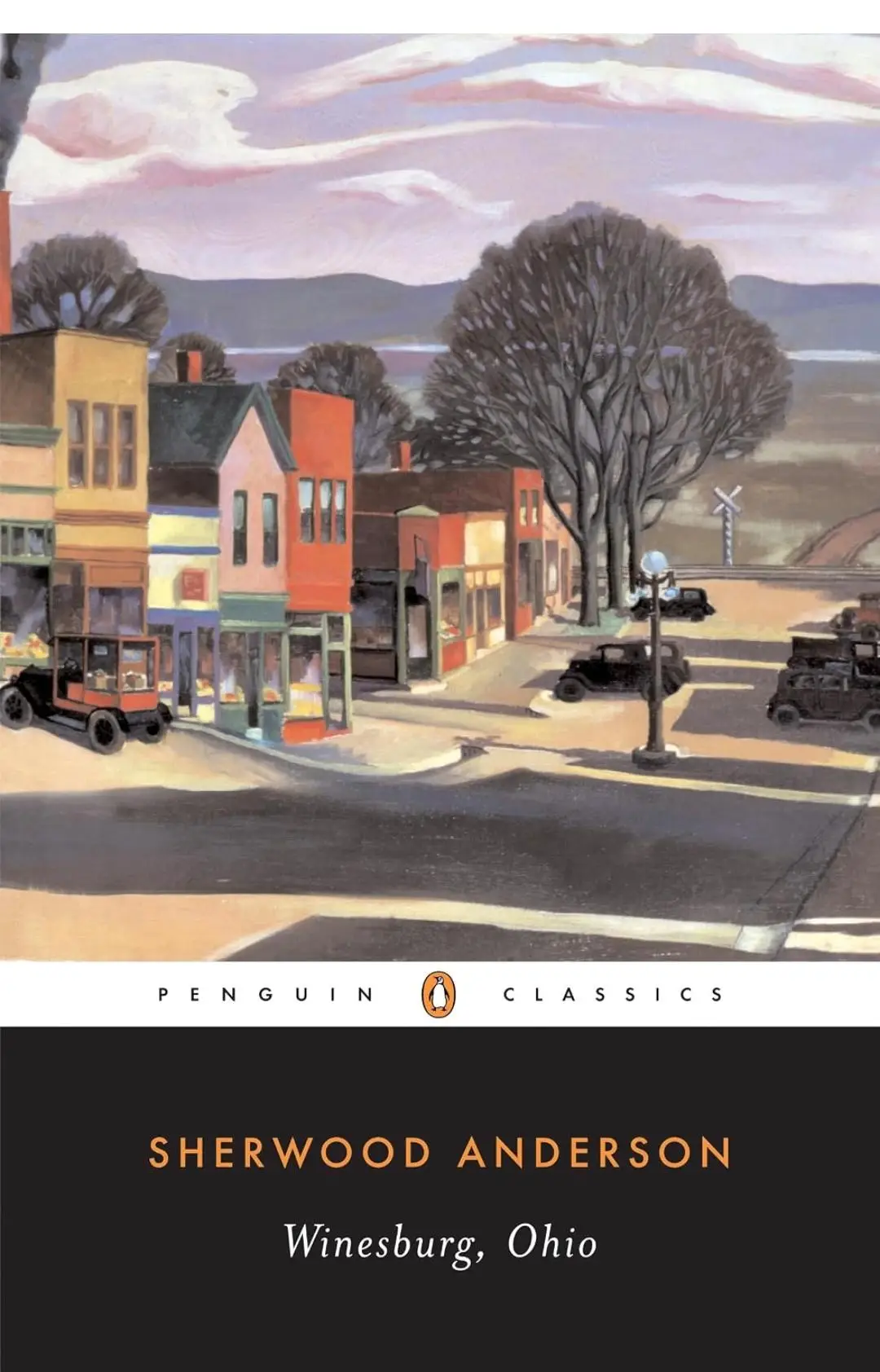

- Title: Winesburg, Ohio
- Author: Sherwood Anderson
- Genre/Subject: American literature
- Publisher: Penguin Classics
- Publication Date: 1919
- Start date: 6/10/2026
- Finish date: 6/15/2026
Winesburg, Ohio is a slim, deceptively simple volume full of interlinked short stories that together form an incisive portrait of early 20th century small-town American life. First published in 1919, Sherwood Anderson’s book uses a fragmented, vignette-driven structure. Meaning each one stands alone but when compiled you see how they connect up. The influence on 20th‑century American fiction was clear to me, and I can see the influence on writers such as Hemingway, Faulkner, and Steinbeck.
So the book is organized as a cycle of stories centered on one George Willard, a young newspaperman at the grandly named Winesburg Eagle. Each story features a glimpse into the lives of the inhabitants of Winesburg. Anderson uses the linked‑story format to produce powerful character effects, so imagine if instead of Romeo and Juliet you have a book for each character: Romeo, Mercutio, Juliet. Each chapter is a focused character study that both stands alone and contributes to the mosaic of life in midwestern, small town America. This structure allows recurring motifs and relationships (notably between George and several townspeople) but I did find it difficult to follow in parts. Maybe an argument could be made that this would work better as a novel with a linear plot structure, but who am I to blow against the wind.
I enjoyed and was surprised by the gritty realism, and his unflinching attention to real human behaviour: people fighting, people fucking, people dying. Anderson labels chapters like “The Book of the Grotesque,” “Hands,” “Death,” “Mother,” and “The Strength of God” to expose the mismatch between inner life and outward behavior, revealing how secrets, thwarted longings, and unarticulated pain shape the character’s and the town’s identity. Anderson’s prose captures these inner tensions through direct, spare sentences and often, surprisingly beautiful imagery without going into rapturous descriptions of a field of wheat. Looking at you Proust. The prose is plain, unsentimental, and sometimes blunt. Anderson avoids ornate description, favoring dialogue and interior monologue to convey character. This restraint often sharpens the detail rather than dulling it down. At other times, it leaves the readers to sense the characters’ emptiness rather than being told about it, and I found myself adding in characters from my own life experience. His occasional repetition of key phrases creates a link between the often wildly contrasting storylines.
I would say that the book’s strength lies in its wide range of characters: lonely women, failed artists, repressed ministers, wounded veterans, and small-town dreamers. Anderson treats most characters with sympathy; even when he shows their failings, he invites understanding of why they are broken. The recurring figure of George Willard functions as a bridge — often less tormented than those he encounters, but deeply affected, learning to see and record human complexity. Willard is a device more than anything, there’s not enough news in a town as small as Winesburg to justify a reporter, let alone an entire newspaper which seems to have Willard as the sole employee, reporter, editor, and printer. Possibly even the town newsboy.
Central themes include loneliness, communication and its failures, repression, sexual longing, spiritual hunger, and the limits of small town life ending at the edge of town. The tension between aspiration and limitation — individuals longing for a larger life but hemmed in by social norms, the edge of town and personal wounds — is powerful. The final chapters gesture toward possible escape or growth with Willard’s budding self-awareness and ultimate decision to leave. I had the 90s country song Small Town Saturday Night by Hal Ketchum in mind while I read Winesburg. Especially this one verse:
Bobby told Lucy, “The world ain’t round
Drops off sharp at the edge of town
Lucy, you know the world must be flat
‘Cos when people leave town, they never come back”
Like any other book there are some limitations and, with a hundred-plus year old book, some dated elements. Some modern readers find occasional lapses into melodrama or heavy-handed symbolism. The label “grotesque” and the sometimes stark character portrayals can feel contrived, or even verging on caricature. I get that, and I can’t argue against that. My only argument would be that there are lots of stories and lots of characters, not every single one is going to be extraordinary. Anderson’s portrayals of women are often sympathetic yet limited by early‑20th‑century assumptions; female characters are frequently defined by emotional suffering or romantic longing rather than agency. Not potted plants exactly but you can sure see the patriarchal influence on their portrayal. Sexuality is handled indirectly and often through repression; while this suits Anderson’s themes, it can feel constrained or ambiguous to contemporary readers seeking fuller representation. This was still the era of “women don’t enjoy it” so take it for what it is.
Significance and legacy
Winesburg, Ohio helped shift American fiction toward modernist sensibilities. Anderson’s emphasis on psychological truth, regional specific themes and the linked‑story form influenced major modernists including Sinclair Lewis and Faulkner. Winesburg helped normalize a focus on ordinary lives as worthy literary subjects. The book remains a key text in American literature courses for its technique and historic importance, and I had never heard of it. I’m glad I did hear of it and it was a good, solid read.
Readers who enjoy character-driven fiction, psychological portraits, and short-story cycles will enjoy this. Readers interested in early American modernism and the evolution from Fenimore-Cooper style western adventures to introspective modernist prose will enjoy this. Readers seeking a fast-paced narrative or a traditional novel with resolved plotlines will likely be disappointed, and those readers wanting contemporary gender and sexual perspectives will likely find Winesburg dated and patrician. Not puritanical, but more: “well we don’t talk about that sort of thing.”
I found Winesburg, Ohio to be a resonant, sometimes haunting study of life in midwestern 20th century rural America. Its spare prose, memorable vignettes, and linked‑story design make it both historically important and still moving to a 21st century reader. Despite occasional melodrama and the dated social assumptions that I mentioned above, it rewards readers who value interior depth and ur-modernist realism. This was a good read and I recommend it, even if you don’t read all the stories I believe there is enough material here to satisfy most modern readers. 4 stars and deserving of each one.
This book made me want to: Make a model railroad based on Winesburg, Ohio.
Overall rating: 
Readability:
Plot:
Other: Cover art by Grant Wood, the American Gothic Grant Wood.