
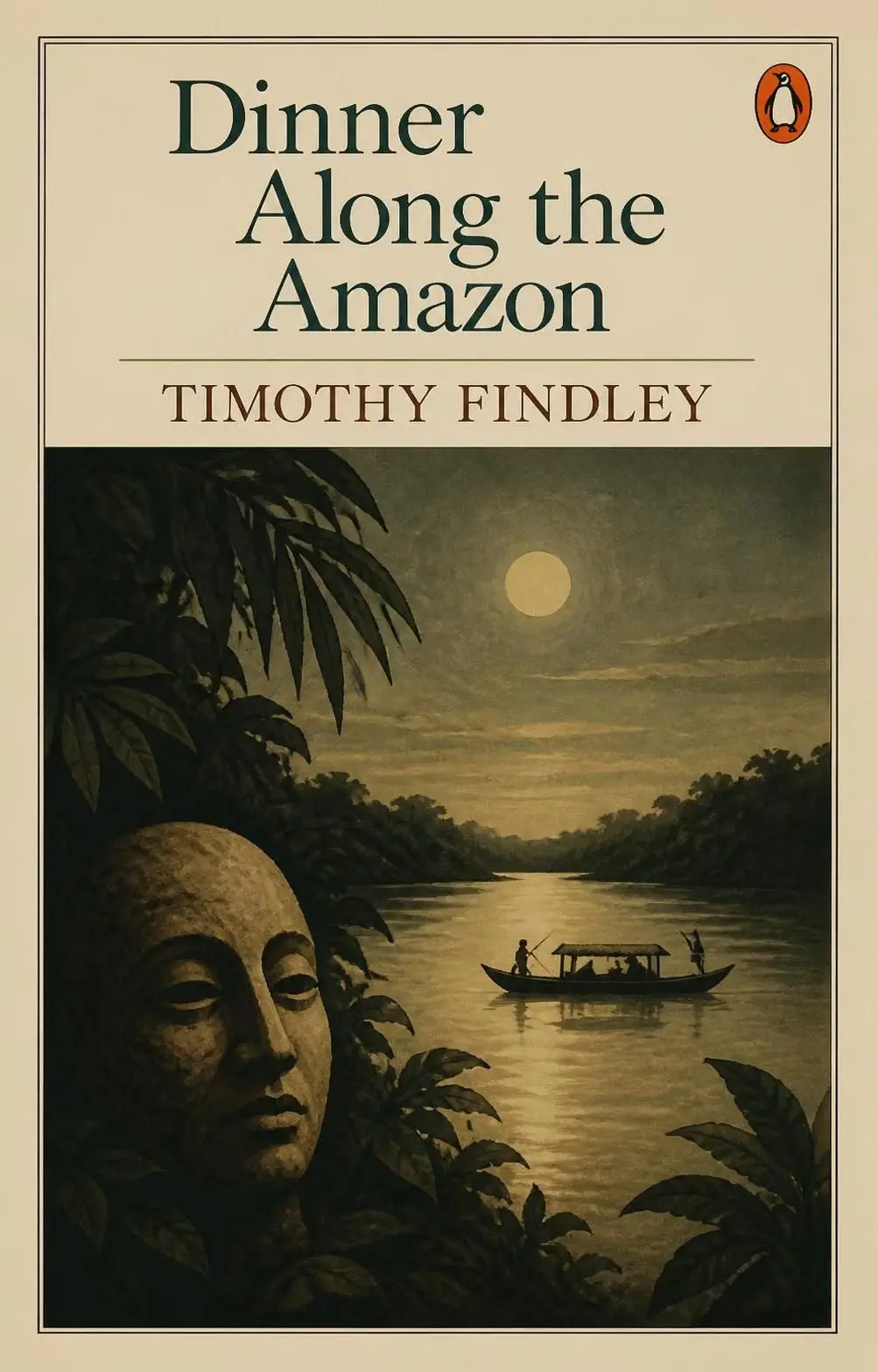

- Title: Dinner Along the Amazon
- Author: Timothy Findley
- Genre/Subject: Canadian literature
- Publisher: Penguin
- Publication Date: 1984
- Start date: 6/15/2026
- Finish date: 6/21/2026
This was alright. Not great, not terrible, just alright. Dinner Along the Amazon is a compact collection of short stories that shows Findley at his most empathic and I guess, literary. I say that because it feels like he’s trying to be literary, rather than it happening organically. Like if you’ve ever got your suit on and went to a gallery opening, you either consciously or unconsciously start to act all artsy. Across twelve stories, he returns again and again to damaged families, failed intimacy, grief, and the long afterlife of war. The book begins with “Lemonade,” one of its most remowned stories, and keeps narrowing in on people trying—and often failing—to connect across distance, silence, and shame.
What makes the collection so strong is its consistency of mood and vision. Findley writes in clear, controlled prose, but the emotional effect is anything but simple: ordinary domestic scenes turn ominous, and private disappointments take on historical weight. Lots of things going on in the outwardly happy families, sex, drugs, booze, lots and lots of booze. War is the collection’s hidden engine, shaping the lives of characters even when it is not directly present. That gives the book a larger moral reach than a typical story cycle would but again, it felt like he was trying too hard to make the stories sad. Like a director making a decent movie into a tear-jerker.
The title story stands out for its complex treatment of relationships, while stories like “War,” “Sometime—Later—Not Now,” and “Hello Cheeverland, Goodbye” deepen the book’s concern with memory, isolation, and the divisions that define a life before and after catastrophe. “Hello Cheeverland, Goodbye” stood out for me as the extraordinary amount of suburban boozing brought back some bad memories for me. Like I could almost feel the hangover starting, that much. The range of settings—from Canadian domestic spaces to European locations— keeps the collection from feeling repetitive, but seems to jump around too much throughout. Like pick a location and stick with it man. I shouldn’t single Findley out for that as many writers do that in anthologies, but I find it distracting, and forced when trying to develop a theme running throughout the stories.
Its main strength lies in the sheer force of Findley’s prose. I know that sounds like I’m trying to be all literary now, but it’s true, Findley earned his place in the Canadian literary pantheon with his masterful writing. Even in the stories that were not my type of thing the writing was consistently excellent. From cover to cover this held true, and in my experience that’s rare for any collection of stories.
Its main weakness, it is that the collection felt emotionally heavy and austere. Not to the point where I didn’t want to pick it up, but to the point that I really liked putting it down. Think of it like listening to a collection of only sad songs. They may be individually absolute classics but you still get tired of being sad, or more accurately being made to feel sad by design.
This was a good read, and I’m glad I read it, but I’m glad I finished it as well if that makes sense. Just like every song isn’t a number one chartbuster, neither is every story. Nor should it be, we live in a world of soul-less ai generated writing, and that’s worse because it is so evenly mundane and uninspiring. So this was good, not great, not horrible, but still human and wonderful in its scope and writing.
This book made me want to: Nothing really, I read it and finished it and that’s good enough.
Overall rating: 
Readability:
Plot:
Other: The line on page 271 when asked what some stranger in her house was doing, the man replies, “I was sent to get the booze.” Honesty and accuracy.