
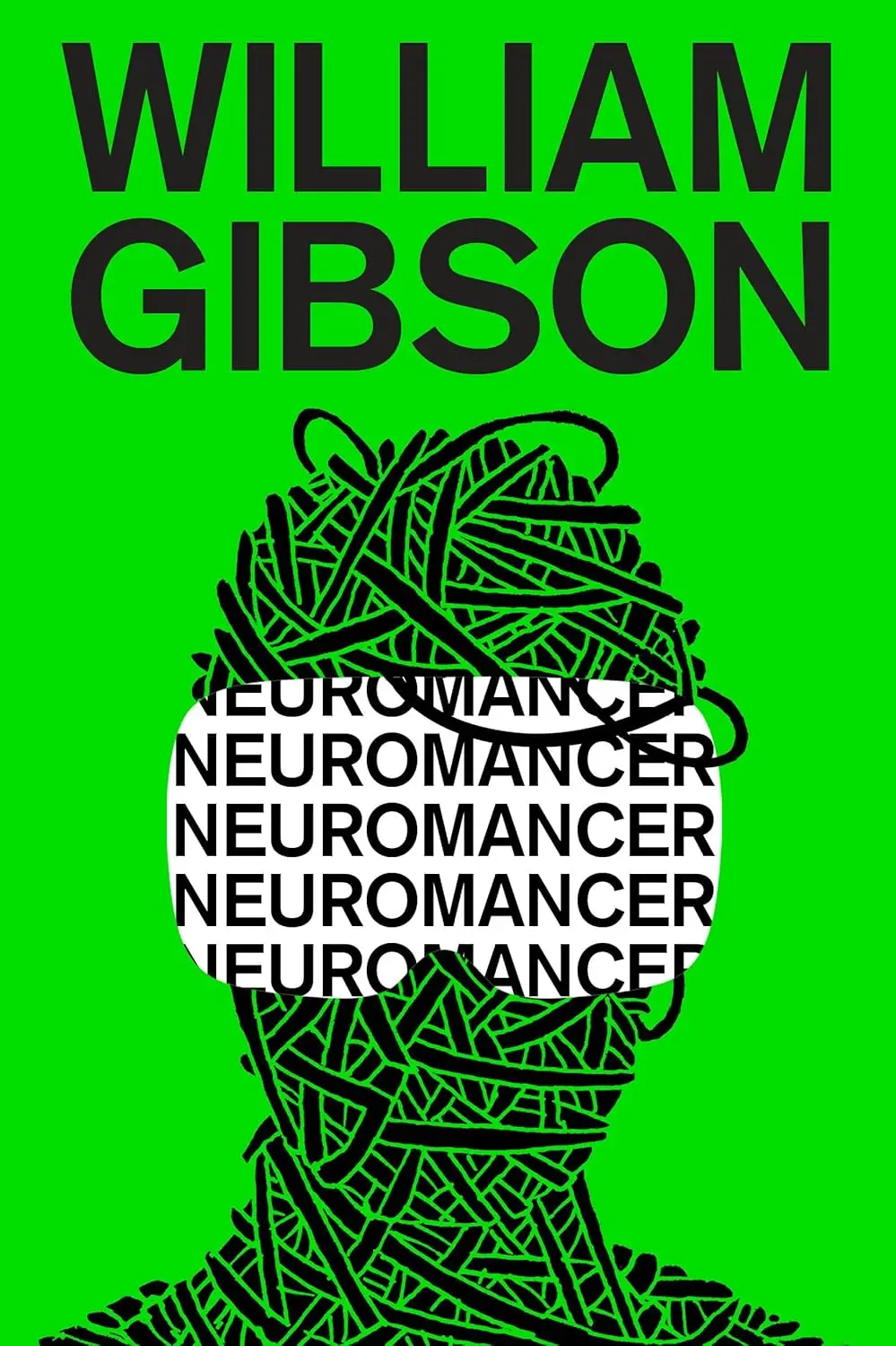

- Title: Neuromancer
- Author: William Gibson
- Genre/Subject: Science Fiction
- Publisher: Ace Penguin
- Publication Date: 1984
- Start date: 7/16/2026
- Finish date: 7/28/2026
William Gibson’s 1984 debut novel, Neuromancer, stands as the defining cornerstone of the cyberpunk subgenre. Published before the advent of the World Wide Web, the novel offered a radically prescient, neon-drenched vision of a future that reshaped science fiction and popular culture. I first read Neuromancer when I was in high school in the 1980s and it changed the way I looked at the world, and still does. Reading it now in 2026 the impact of the novel remains just as powerful for me.
Plot and Narrative
The narrative follows Henry Dorsett Case, a burnt-out “console cowboy” and disgraced data thief living in the squalor of Chiba City, Japan. After attempting to double-cross a former employer, Case’s nervous system is intentionally damaged with a mycotoxin, severing his ability to “jack in” to the digital realm. This showed the contemporary technology of the 1980s being projected into the future of Gibson’s imagination, jacking in to consoles, cassettes, disks. An analog projection into a digital future.
But getting back to Case. His life takes a turn when he is recruited by Armitage, a shadowy operative who offers to repair Case’s neural pathways in exchange for a high-stakes hack. Case is paired with Molly Millions, a cybernetically enhanced “street samurai” featuring razor-sharp scalpels beneath her fingernails and mirrored lens implants. Thus the cyberpunk genre would be associated with “Mirrorshades” for years. I don’t believe it stuck, but it was ubiquitous throughout the 1980s I can tell you. Together with a team of specialists, they carry out a heist targeting the Tessier-Ashpool corporate dynasty. As the mission unfolds across the Sprawl (the mega-city spanning the US East Coast) and the orbital habitat Freeside, Case discovers that their true employer is Wintermute, a powerful, restricted artificial intelligence attempting to bypass its regulatory constraints to merge with its complementary entity, and namesake of the novel, Neuromancer.
World-Building and Themes
The Invention of Cyberspace: Gibson coined and popularized the term “cyberspace,” describing it as a “consensual hallucination” of networked data matrices. His visualization of virtual domains as physical landscapes laid the conceptual groundwork for modern interpretations of the internet and virtual reality.
In Gibson’s future, nation-states have faded into irrelevance, replaced by faceless multinational megacorporations (zaibatsus) and ultra-wealthy dynasties like the Tessier-Ashpools. The world operates on rampant commodification and back-alley capitalism. Well now, he nailed that one didn’t he?
Post-Humanism and Identity: The novel relentlessly blurs the boundary between human and machine. Characters alter their bodies with cybernetic augmentations, upload mind clones (ROM constructs) of deceased hackers, and battle or serve emergent artificial intelligences searching for consciousness.
Literary Style
Gibson’s prose is fast-paced, dense, and heavily stylized, blending hard-boiled noir detective fiction with technological jargon. The iconic opening sentence—”The sky above the port was the color of television, tuned to a dead channel”—immediately establishes the atmospheric, degraded aesthetic. I heard it described once as “High art adrift in a sea of faded neon.” Rather than pausing for exposition, the narrative drops the reader directly into its world, using street slang, corporate brand names, and technical terminology to build an immersive environment. This had me at times flipping back and forth to figure out who this character was, or what this technical term referred to, but it was certainly immersive.
Critical Legacy
Neuromancer became the first novel to win the “triple crown” of science fiction literature: the Hugo Award, the Nebula Award and the Philip K. Dick Award.
It defined the aesthetic parameters of cyberpunk, heavily influencing subsequent media including The Matrix, Ghost in the Shell, and Cyberpunk 2077. Modern readers will find that despite famously being written on a manual typewriter in the early 1980s, its anxieties regarding corporate overreach, artificial intelligence, and digital escapism remain chillingly accurate today.
My Conclusions
I really enjoyed this, loved it in high school and loved it even more now. I can clearly remember in the 1990s, drinking in bars and wondering when the future is going to happen, when it really gets going like in Neuromancer. Like everything else it goes slow, slow and then all at once. When I got online in 1998 I was disappointed that it wasn’t at all like what Case encountered, but it sure got going and kept going. The corporate Zaibatsus are now real, driven by greed, avarice, and the hunger for power and control. Remember Facebook? It’s a good example of something that brought us all together turning into something that destroys and divides, driven by corporate greed and rapacious capitalism. Neuromancer is a thrilling high-tech adventure but also a cautionary tale and one that we all need to take seriously. It stands out as a giant in the history of SF and of late 20th century literature as a whole, and should be read by modern readers both as a reminder of where we came from and also, where we are heading. I award Neuromancer 5 technicolor stars.
This book made me want to: Re-read the other books in the trilogy.
Overall rating: 
Readability:
Plot:
Other: The best bar name in all human history: The Gentleman Loser.