
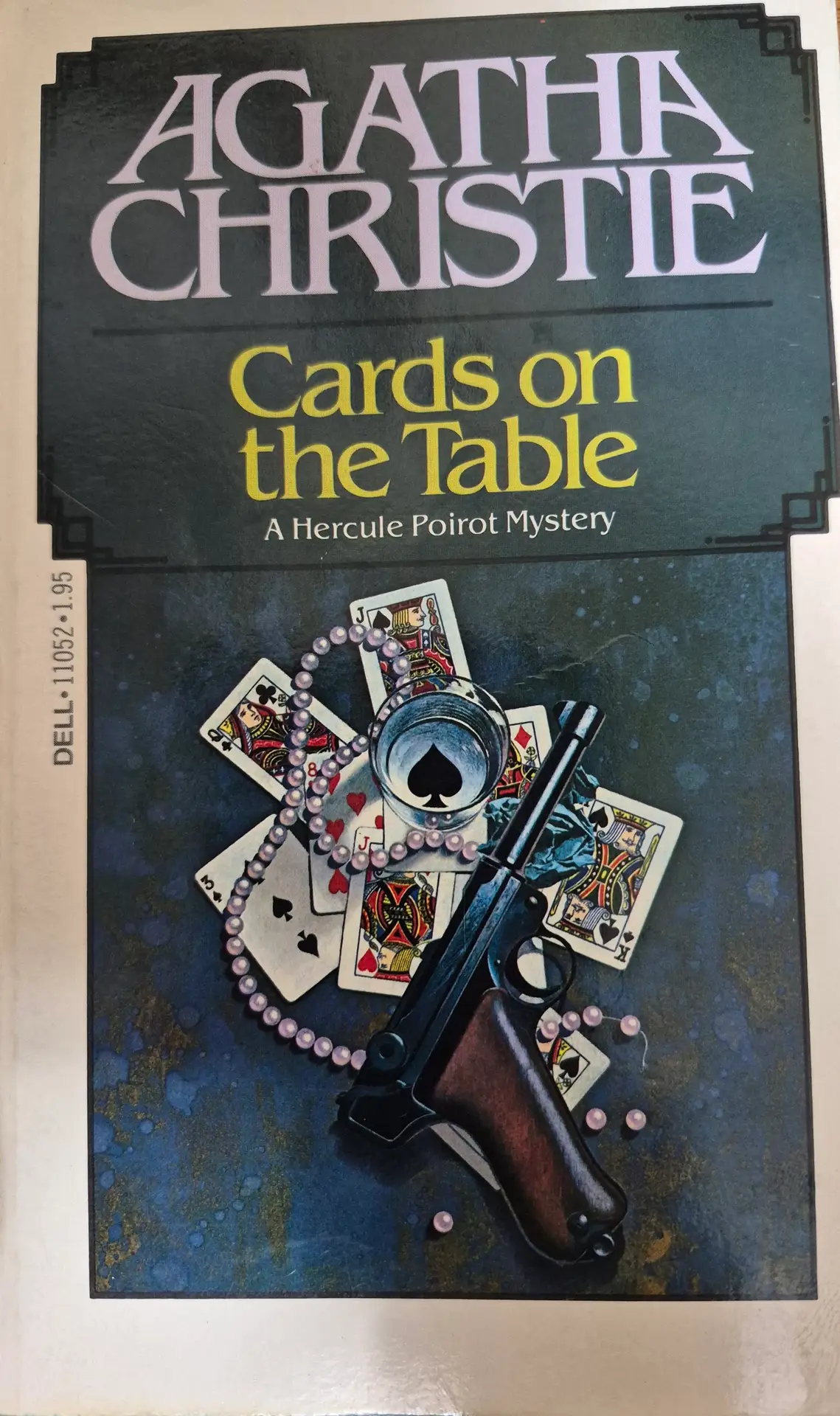

- Title: Cards on the Table
- Author: Agatha Christie
- Genre/Subject: Mystery fiction
- Publisher: Dell
- Publication Date: 1936
- Start date: 8/17/2026
- Finish date: 9/23/2026
This was an excellent closed room mystery that despite its venerable age still delivered, to borrow a Bridge term from the novel: in spades. In a peculiar oversight on my part I had read several Agatha Christie mysteries but in my literary life I had never read one featuring one of her most famous detectives, Hercule Poirot. He’s not French, he’s Belgian dammit. Get it right!
First published in 1936, Cards on the Table stands out in Agatha Christie’s vast bibliography as a masterpiece of closed-room psychology. Departing from her usual reliance on physical clues, timelines, and alibis, Christie constructs a murder mystery where the primary evidence consists of bridge scores, psychological profiles, and behavioral tendencies. The result is one of Hercule Poirot’s most intellectual and elegant cases.
Premise and Structure
The story opens with Mr. Shaitana, a flamboyant and sinister art collector who boasts to Hercule Poirot that he collects not just works of art, but unpunished murderers. To prove his point, Shaitana hosts a dinner party with eight guests, neatly divided into two distinct groups:
- The Sleuths: Hercule Poirot, mystery novelist Ariadne Oliver (making her first appearance alongside Poirot), Secret Service agent Colonel Race, and Superintendent Battle of Scotland Yard.
- The Suspects: Dr. Thomas Roberts, Mrs. Lorrimer, Major Despard, and Miss Anne Meredith—four individuals whom Shaitana believes have previously committed murder and gotten away with it.
Following dinner, the party splits into two rooms to play bridge. The four investigators sit in one room, while the four suspects play in another with Mr. Shaitana resting by the fireplace. By the end of the evening, Mr. Shaitana is found stabbed through the heart with a stiletto from his own collection. Because no outsider entered the room, one of the four bridge players must be the killer.
Analysis of Themes and Execution
Psychological Deduction Over Physical Clues
Christie intentionally limits the physical evidence. There are no fingerprints, no missing weapons, and no contested timelines—all four suspects had opportunities to walk to the fireplace while dummy during the card games. Instead, the deduction hinges entirely on personality and card strategy. Poirot reconstructed the murder by analyzing the bridge scoresheet, recognizing that a player’s style of play (aggressive, cautious, or precise) reveals their psychology and potential motive for murder.
Ensemble Dynamics
The presence of four distinct investigators allows Christie to contrast different investigative methodologies:
- Superintendent Battle focuses on routine police work and background checks.
- Colonel Race examines international connections and high-level motives.
- Ariadne Oliver relies on female intuition (and serves as Christie’s humorous self-caricature).
- Hercule Poirot orchestrates the psychological analysis, observing how each suspect handles pressure.
The Misdirection
Christie excels at manipulating reader expectations. By establishing early on that all four suspects are capable of murder, she creates a double layer of suspense: identifying who killed Shaitana requires uncovering their original, unpunished crimes.
Strengths and Weaknesses
| Aspect | Evaluation |
|---|---|
| Plot Design | Highly innovative locked-room premise with an exceptionally tight cast. |
| Characterization | Strong psychological depth among the suspects, making each plausible. |
| Pacing | Steady and analytical, focusing on dialogue and intellectual puzzles over action. It never rushed, it never dragged. |
| Accessibility | Readers unfamiliar with bridge rules may find the score breakdown dense, though Poirot explains the essential deductions clearly. I know more about African dialects in the heart of the Congo than I do about bridge, so I number among them. |
Final Verdict
Cards on the Table is an exemplary whodunit that demonstrates Agatha Christie at the height of her narrative control. By stripping away physical clues and relying purely on character analysis, she delivers a clever, fair-play mystery that remains one of her most rewarding novels. I loved this and recommend it to anyone who is looking for a nice fun British mystery.
This book made me want to: Read more Hercule Poirot mysteries.
Overall rating: 
Readability:
Plot:
Other: Emphasis on spectacular moustaches.