
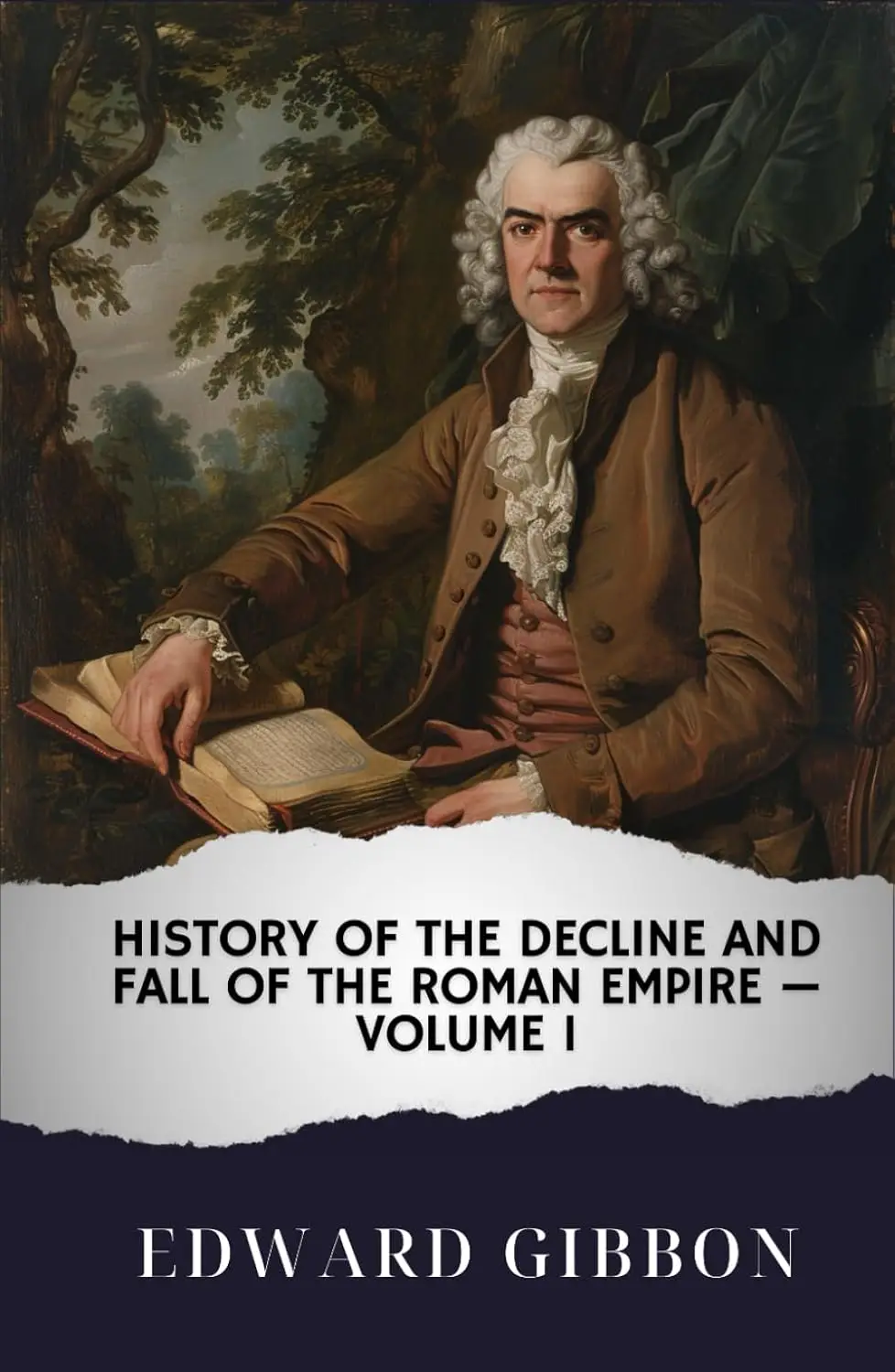

- Title: History of the Decline and Fall of the Roman Empire
- Author: Edward Gibbon
- Genre/Subject: History
- Publisher: Modern Library
- Publication Date: 1938
- Start date: 1/1/26
- Finish date: 3/20/26
Review:
In the second century of the Christian era the Empire of Rome comprehended the fairest part of the earth and the most civilized portion of mankind. Thus begins Edward Gibbons epic… epic is an understatement. More like massive, exhaustively researched history of the decline and fall of the Roman Empire. Now, most people, myself included thought it was the rise and fall of the Roman Empire, but that’s not true. That’s a confusion with another book which is called the rise and fall of the Third Reich. This history begins after the Julius Caesar – Augustus Caesar days and goes on to describe the anno domini misadventures of the Roman Empire including when it was split into two halves and up to the sack of Rome by Alaric the Goth.
The Decline and Fall of the Roman Empire covers the Western Roman Empire from the height of its power in the 2nd Century AD (specifically starting with the reign of Trajan or the Antonines) through to the fall of the Byzantine (Eastern) Empire in 1453. This being volume 1 it ends with Alaric and the goth domination of Rome.
The bifurcation of the empire began in earnest with the reforms of Diocletian in the late 3rd century and was cemented by Constantine the Great, who moved the capital to Byzantium (renamed Constantinople) in 330 AD.
The Western Roman Empire, centered (obviously) in Rome and later Milan and Ravenna. It collapsed in 476 AD when the last emperor, Romulus Augustulus, was deposed. The Eastern Roman Empire (The Byzantine Empire) was centered in Constantinople and It persisted for nearly a thousand years after the fall of the West. A thousand years!
The word “Rise” is noticeably absent from Gibbon’s title. He essentially treats the “rise” as a given and focuses entirely on the process of disintegration, cheery stuff here. Gibbon purposefully skips the era of Julius Caesar and Augustus. He begins his narrative in the 2nd Century AD, which he famously considered the period “in which the condition of the human race was most happy and prosperous”—the age of the “Five Good Emperors.”
Reading 1,304 pages in 79 days is a massive feat—that’s an average of about 16 or 17 pages a day of some of the densest, most syntactically complex prose in the English language. It was tough, but I admire the scholarship and incredible scope of the book. My admiration for Gibbon’s scholarship is well-placed; he is often cited as the first “modern” historian because he moved away from mere storytelling and pioneered the use of primary source citations and critical analysis. Footnotes. Footnotes. Oh my goodness footnotes.
Gibbon’s ability to bridge the 1,500-year gap to his time, using nothing but his own intellect and the dusty archives of 18th-century Europe is nothing short of amazing. He didn’t have google, computers, ai, searchable databases, nothing but a quill pen and an extraordinary personal drive.
The Mechanics of the Decline as I interpret it, and I feel as Gibbon intended to convey are as follows:
*The primary irony of the Roman military strategy: their greatest strength eventually became their undoing. The legions had to approve the emperor, so essentially the army selecting its own officers. This process, often considered mutinous, was a slow-motion transformation of the Empire’s backbone.
* The Foreign Legions: As the Romans began enlisting the “flower of the youth” from the very tribes they conquered this process was called “barbarization”. By the late Empire, the Roman army was largely composed of Germanic soldiers.
* The Knowledge Gap: These soldiers learned Roman tactics, engineering, and discipline. When they eventually returned to their tribes—or rebelled against Rome—they were no longer “barbarians” fighting with disorganized fury; they were veteran commanders who knew exactly how to dismantle a Roman phalanx.
* The Völkerwanderung: This “Migration of Peoples” wasn’t just a series of raids; it was a domino effect. Groups like the Huns pushed the Goths and Vandals, who in turn pushed into Roman territory. Because the borders were so vast, Rome couldn’t stop the sheer volume of people moving across the Rhine and Danube.
*The Contrast in Longevity: It is quite a paradox that while the Western Empire crumbled under the weight of these migrations and internal rot by 476 AD, the Eastern Empire (Byzantium) adapted and survived. Partly this was due to geography, Rome had vulnerable land borders while Constantinople (“The City”) was impregnable. Nearly impregnable anyway.
These points are in addition to the more obvious and often repeated roads to decline: loosening of discipline both in the military and in the manners of the populace, incompetency of emperors, emperors who listen to their sycophants, moral and physical decline, and over-expansion.
After the first few chapters I found I was getting into the rhythm of the historian’s voice so to speak. Gibbon’s style is famous for its “Augustan” prose—balanced, rhythmic, and heavily reliant on irony and footnotes. He doesn’t just tell you a fact; he paints a philosophical picture of it. Once you find that rhythm, the “Decline and Fall” feels less like a textbook and more like a long, brilliant conversation with a very witty, albeit slightly cynical, tour guide. When the Decline and Fall was first published it was a huge bestseller. The upper classes would often engage a servant to read it to them when they were dressing for dinner. I’m not upper class enough to employ a servant to either dress me, cook me dinner, or read me Gibbon, but I can certainly see what a remarkable book this is.
Now you may be wondering, am I reading volume 2 now? Short answer: no. Longer answer: I have set a date of January 1, 2027 as my beginning date for that. Would I recommend this book? It’s a huge commitment and very dense reading, so no, not really. If you’ve already scaled some literary mountains: think Ulysses, Life of Johnson, The Iliad, then by all means give it a go. Don’t be disappointed if you tap out after a hundred or two hundred pages, it’s a hard laborious read. But let me also state that it is actually quite exciting in parts and as I stated above the prose is superb, if rather dated seeming to 21st century readers. I’m happy I read it but also happy that it’s finished for now. I climbed my Everest but I’m not rushing over to climb K2 now. I feel a strong sense of accomplishment and I am happy that I have learned so much about something I had only a superficial knowledge of. All in all, well done me, and well done Mr. Gibbon.
This book made me want to: Finish it.
Overall rating: 
Readability:
Plot:
Other: Thinking that I might name my next cat Diocletian. Dio for short.