
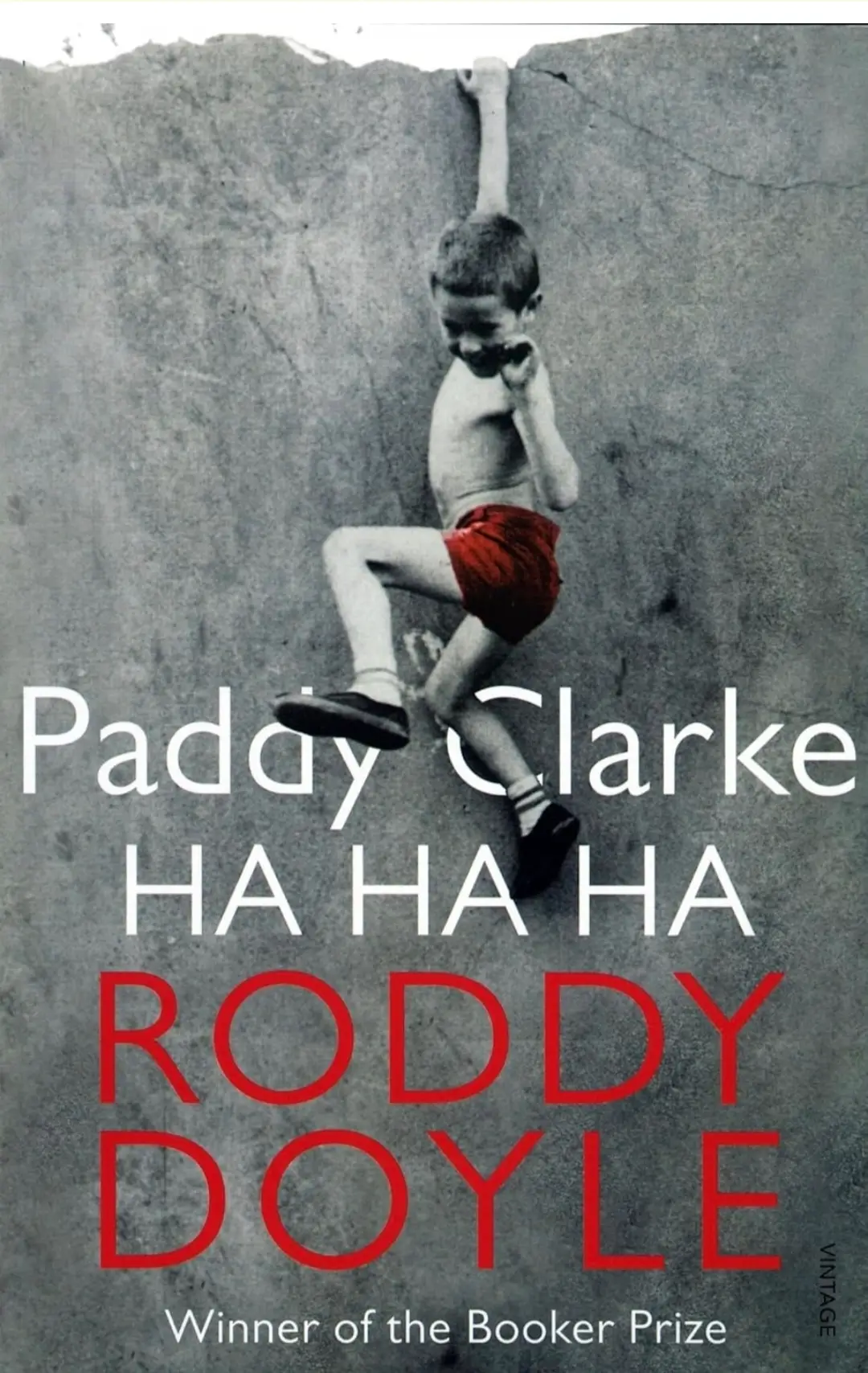

- Title: Paddy Clarke Ha Ha Ha
- Author: Roddy Doyle
- Genre/Subject: Booker Prize winner, Irish literature
- Publisher: Minerva
- Publication Date: 1993
- Start date: 4/20/26
- Finish date: 4/23/26
I want just one Irish author to write in a style other than stream of consciousness, even just once. James Joyce kicked it off with Portrait of the Artist, then Sam Beckett carried the ball with Murphy and various other novels, and now Roddy Doyle has entered the chat. I did not like this book, not one bit, and I can’t, and can, believe it won the Booker. I have a theory, which I will go into later in this review.
From a contemporary editorial review: Roddy Doyle’s Booker Prize-winning novel, Paddy Clarke Ha Ha Ha, published in 1993, offers a visceral and linguistically authentic immersion into the world of a ten-year-old boy in 1968 Barrytown, a fictional suburb of North Dublin. The narrative is constructed as a stream of consciousness, capturing the fragmented, energetic, and often brutal logic of childhood.
A visceral and linguistically authentic immersion. Fuck off. Or, rather, let me translate that from ponce-ese into Neilosian: A long and incoherent stream of words with no paragraphs, no chapters, no structure, no plot that winds along for 282 pages with no resolution. Why stop at 282? To quote former Flame’s coach Darryl Sutter: I think he had to go for a shit. From the same review:
The novel eschews a traditional linear plot in favor of a series of vignettes that mirror the way a child processes memory and daily life. Doyle utilizes a distinct narrative voice that is both naive and observant, capturing the specific cadence of Dublin slang and the chaotic internal monologue of a pre-adolescent. To quote Coach Sutter again, “If you say so.”
Okay, essentially the novel centers around the adventures of our ten year old protagonist and narrator, Patrick “Paddy” Clarke who lives in the fictional Irish town of Barrytown in 1968. How they play pick-up football, how they get into trouble with the teachers, how they interact with the adults in the town. Sounds charming, nostalgic even, right? Well sure, maybe, if you don’t mind endless pages banging on about schoolyard games, neighborhood exploration, and the encroaching silence of a deteriorating household. So, to break it down a little further so you don’t have to actually read it:
Key Themes
-The Loss of Innocence
Paddy begins the novel as a confident leader of his peer group, engaged in casual cruelty and adventurous play. As the story progresses, his world narrows and darkens. His fascination with the physical world (such as his weird obsession with Father Damien and the lepers) serves as a metaphor for his growing awareness of suffering and decay. You get older you start to understand there is a skull beneath all of our skins.
-Domestic Deterioration
The central emotional arc involves the crumbling marriage of Paddy’s parents. Unlike a mature narrator who might analyze the reasons for the conflict, Paddy experiences the breakdown through overheard arguments, heavy silences, and the physical space between his mother and father. His attempts to intervene—such as staying awake to prevent fights—highlight the helplessness of a child caught in adult turmoil.
-Social Hierarchy and Violence
The neighborhood boys operate under a code of conduct defined by toughness and the avoidance of being “sentimental.” Violence is a constant, whether it is the casual “dead legs” given by friends or the more structured discipline of the classroom. Paddy’s struggle to maintain his status while his internal world collapses provides a sharp look at the performance of masculinity in youth. And now, in 2026 we observe this in the Manosphere and podcast bro nouveau macho ethos.
-Linguistic Authenticity: The prose is rhythmic and colloquial, utilizing the vernacular of working-class Dublin to establish a grounded sense of place. Doyle does this with authority and authenticity.
-Sensory Detail: Descriptions focus on the immediate and the tangible—the smell of hot tar, the sting of a scrape, and the intricate social hierarchies of the schoolyard. I have to give credit where it’s due here, this is done masterfully throughout.
My Conclusions
The avant garde is always celebrated by critics, reviewers, and literati. This is true in music, literature, art, and even the culinary world. It does not mean it’s good in the sense that we know things are good, entertaining, enjoyable. It does not follow, however, that it is bad, in the sense that we know things to be bad, offensive, poorly constructed, tasteless. Where I’m going with this is the Booker Prize judges and reviewers are no slobs, you don’t get stupid people even asked to read the nominated novels, you just don’t. Think of it in terms of music criticism, like how if you ask Dave Grohl or Art Garfunkel what they’re listening to it is usually something completely unexpected. As musicians they understand things differently than non-musicians like myself, they hear it differently, they appreciate the technical skill involved. So this was an author’s version of art for art’s sake, and I just didn’t like it, could not get into it, and did not enjoy the experience. I appreciate it for a Booker Prize winner, and for the reasons I noted above, but I don’t recommend reading it, personally.
This book made me want to: Eat more potatoes.
Overall rating: 
Readability:
Plot:
Other: Another Booker winner checked off my list