
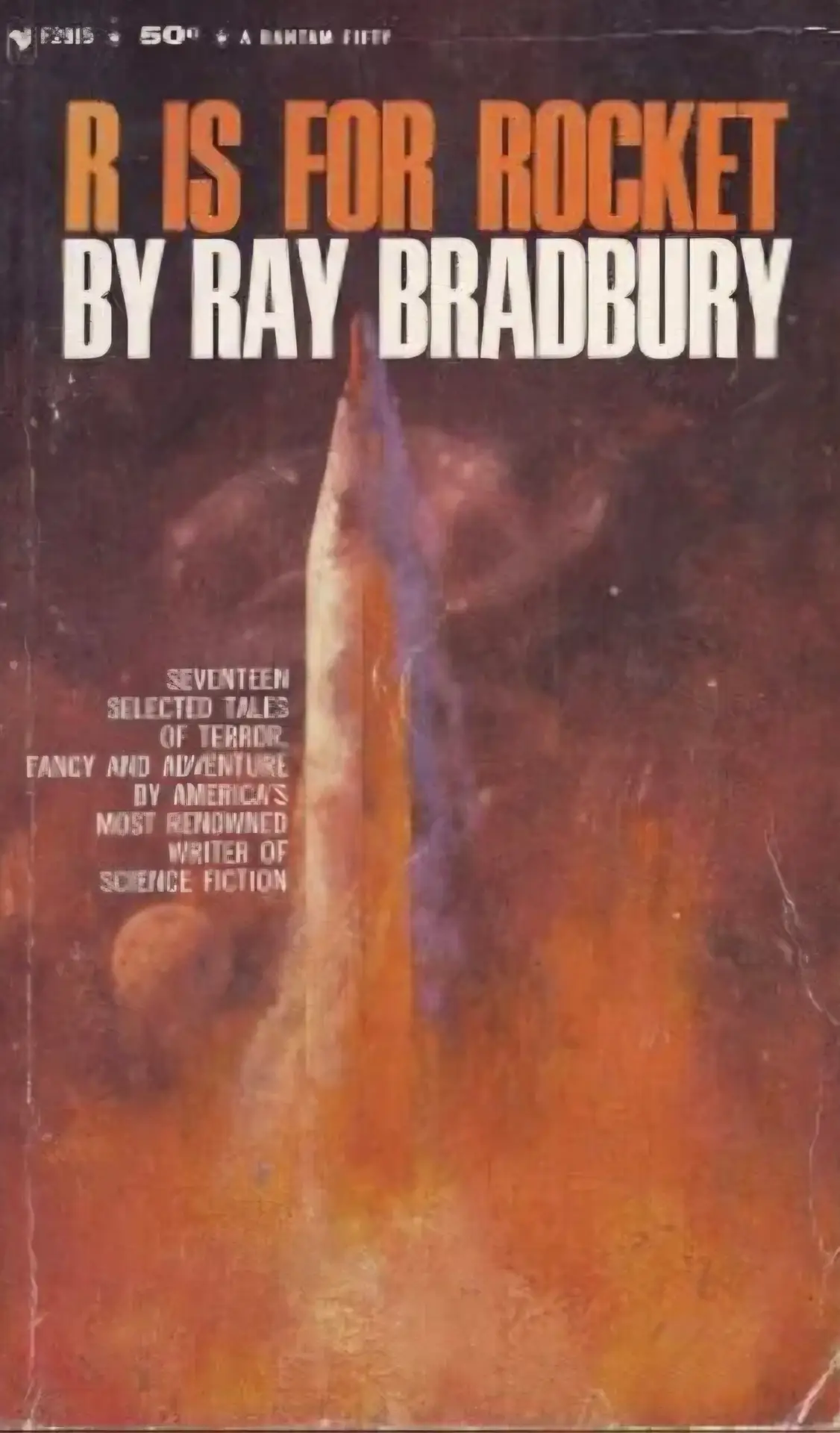

- Title: R is for Rocket
- Author: Ray Bradbury
- Genre/Subject: Speculative fiction
- Publisher: Bantam Pathfinder
- Publication Date: 1966
- Start date: 5/2/26
- Finish date: 5/6/26
Overview: This was amazing.
Overview with more than three words:
Published in 1962 by Doubleday (and subsequently as the version I read, a popular Bantam paperback), R is for Rocket serves as a curated introduction to the lyrical prose and speculative imagination of Ray Bradbury. While many of the seventeen stories had appeared in earlier collections like The Martian Chronicles or The Illustrated Man, or The October Country, this anthology was specifically designed to capture the newly minted “Young Adult” market of the 1960s, focusing on themes of space exploration, and the intersection of technology and the human spirit.
This collection is characterized by Bradbury’s signature Midwestern magic realism where the vacuum of space feels as familiar as an Illinois ravine, in his own “hometown” of Green Town, Illinois. Some key themes I identified. Some, as there are so many in this excellent collection:
• The Romanticism of Space: Unlike the hard science fiction of his contemporaries, 1940s and 50s Bradbury treats rocketry as more of a poetic endeavor. The title story, “R is for Rocket,” explores the aspirational yearning of youth and the solemnity of the astronaut as a modern knight. Rocket Man is another, where he seems to prefigure the sentiment in Elton John’s classic of the same name, “All the science, I don’t understand, it’s just my job five days a week.”
• Nostalgia and Loss: Stories such as The Rocket depict the democratization of space travel through the lens of a poor family’s sacrifice, emphasizing emotional truth over technical accuracy.
• The Natural World vs. Progress: In The Fog Horn, Bradbury explores the loneliness of a prehistoric creature drawn to the artificial wail of a lighthouse, a masterful meditation on evolution and isolation.
• The Mechanics of Time: “A Sound of Thunder” remains the collection’s most famous entry, introducing the “Butterfly Effect” through the narrative of a botched prehistoric safari. So THAT’S where that comes from!
Literary Style and Impact
Bradbury’s writing in this anthology is notably rhythmic and sensory. Notably. Like beat poetry in places and I mean that in a good way. He utilizes heavy metaphor and personification to breathe life into inanimate machinery, or a lighthouse, or a pair of tennis shoes. The 1962 publication arrived at the height of the Space Race, making its themes of planetary exploration and nuclear anxiety particularly resonant for its contemporary audience, and indeed for a modern audience. We still go into space, which is great, and we still have nuclear bombs which is not great. And one nuclear arsenal in particular is in the hands of a giant orange whiny toddler, but I digress.
This (1966) edition of R is for Rocket provides a broad spectrum of Ray Bradbury’s capabilities. The following works represent the most influential selections within the volume.
R is for Rocket
This story follows a young boy’s selection for an astronaut training program. It remains a definitive example of mid-century optimism regarding the burgeoning Space Race and the dreams of a generation.
The Fog Horn
In this atmospheric tale, a prehistoric sea monster mistakes the moan of a lighthouse foghorn for the cry of its own kind. It is widely recognized as a masterclass in tone and, I learned, was adapted into the film The Beast from 20,000 Fathoms.
The Rocket
A poor father constructs a mock rocket out of aluminum and mirrors to provide his children with the sensory experience of space travel. This selection highlights Bradbury’s career-long focus on human emotion and the power of imagination over technical hardware.
A Sound of Thunder
Time travelers venturing into the prehistoric past inadvertently alter the future by stepping on a single butterfly. This work is credited with popularizing the concept of the “Butterfly Effect” within popular culture and speculative fiction.
The Long Rain
A group of soldiers stranded on a tropical Venus struggles against a relentless, maddening rainfall that never ceases. The story serves as a profound exploration of psychological breakdown and the hostility of alien environments. Didn’t we see this in the 90s with Biosphere 2?
The Sound of Summer Running
5 pages about a pair of tennis shoes. It took me three tries to get through this masterpiece as I was so overcome with emotion that I had to put it down. Willa Cather’s The Song of the Lark is the last time I can think of this happening to this extent. There is an old saying about what pornography is, and the answer is you can’t say exactly but you know it when you see it. Thus with a perfect story, what is it, what does it contain? Dunno, but I knew it the moment I began this perfect story.
Critical Legacy
From an editorial review: “R is for Rocket stands as a testament to Bradbury’s ability to bridge the gap between pulp science fiction and high literature. It avoids the cold, clinical nature of 1950s “Golden Age” sci-fi in favor of a lush, evocative style that prioritizes the “why” of human exploration over the “how” of rockets and space travel. For collectors and scholars, the 1962 paperback remains a quintessential artifact of Mid-Century modern speculative fiction.” Well then. I try to avoid calling anything quintessential, but I quoted this review because it sums it up so beautifully. You don’t read this book as much as you feel it, a deep down connection at an emotional level. The coveted Neilosian 5 Stars are well merited here.
This book made me want to: Resurrect Ray Bradbury so he could keep writing forever.
Overall rating: 
Readability:
Plot:
Other: The inclusion of the novella Frost and Fire. At around 40 pages it is by far the longest inclusion in this collection and it is often omitted from other collections of Bradbury stories. An amazing piece of work all by itself and a wonderful addition to this collection.