
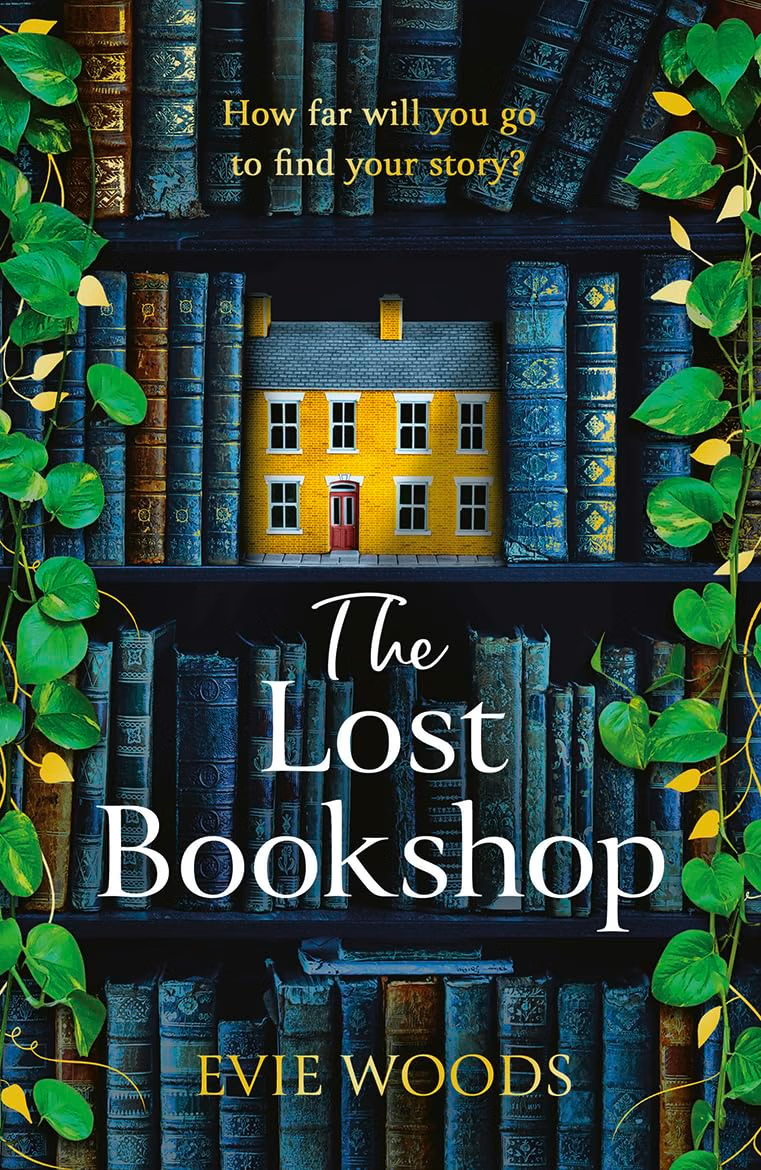
- Title: The Lost Bookshop
- Author: Evie Woods
- Genre/Subject: Mystery fiction
- Publisher: Harper Collins
- Publication Date: 2023
- Start date: 11/1/2026
- Finish date: 11/13/2026
From an editorial review: The Lost Bookshop by Evie Woods (a pseudonym for Irish author Evie Gaughan), published in 2023, is a dual-timeline novel blending historical fiction, magical realism, and romance. Set primarily in Dublin, Paris, and London, the book explores the enduring power of literature, female independence, and the hidden connections that bind people across generations.
Well, if you say so. I really tried to like this and gave it an honest read, so I’ll leave it an honest review. This was a rom-com in book form, I kept waiting for Hugh Grant and Julia Roberts to pop out of the pages. But, that would at least be fun and romantic. Instead it was full of domestic abuse horror, alcoholism and broken families. My Big Fat Irish Drunken Brawl Wedding. But let’s go through the plot first.
Plot Overview
The narrative unfolds through three distinct perspectives across two timelines:
Opaline Carlisle (1920s): A young woman in post-WWI England who flees an arranged marriage and an awful family. She escapes to Paris, where she works at Sylvia Beach’s famous bookshop, Shakespeare and Company, before eventually moving to Dublin to open her own rare bookshop on Ha’penny Lane. Of course she meets Hemingway who hits on her and looks up her skirt, James Joyce who is drunk and still somehow Oscar-Wilde-Level droll and witty, and learns the rare book trade seemingly by doing nothing more than cataloging and shelving books.
Martha (Present Day): A woman escaping an abusive marriage in London who arrives in Dublin with virtually nothing. She secures a job as a live-in housekeeper for Madame Bowden, an eccentric elderly woman living in a grand, crumbling Georgian townhouse next to a vacant lot where a mysterious bookshop once stood. She keeps having dreams of snatches of a story and every time she immediately rushes down to get them tattooed on her back. Seriously? Seriously.
Henry (Present Day): A British scholar obsessed with tracking down a lost manuscript by Emily Brontë. His academic quest leads him to Dublin and directly into Martha’s orbit, as the clues point toward the vanished shop on Ha’penny Lane.
As Martha and Henry begin working together (and fucking) to uncover the history of the missing building, they realize the shop itself possesses a semi-sentient, magical quality—appearing only to those who truly need it.
Key Themes
The Sanctuary of Books: Literature is portrayed not merely as entertainment, but as a literal lifeline. For Opaline and Martha, books provide financial independence, intellectual awakening, and physical refuge from patriarchal control. I really enjoyed this, and descriptions of books breathing on their shelves, waiting to disclose their stories.
Surviving Domestic Abuse: Both primary female protagonists, Opaline and Martha, endure severe emotional and physical control from the men in their lives. Woods examines the psychological toll of abuse alongside the immense courage required to rebuild an identity from scratch. I didn’t enjoy having to read this but I have to admit that it was dealt with very sensitively and honestly.
Magical Realism: The titular bookshop (titular, get a load of me eh?) acts as a liminal space that bends the rules of time and geography. Rather than relying on heavy fantasy world-building, the magic is subtle, atmospheric, and tied closely to emotional necessity and destiny. Things like books appearing from trees growing in bedrooms, mysterious hidden panels in sewing boxes, I didn’t love this but I didn’t hate it either.
Strengths
Writing.The writing was strong solid prose, and didn’t devolve into sentimentality despite the story itself doing exactly that.
Atmospheric descriptions. This was done brilliantly, and the author was obviously someone who had actually experienced the rain of Dublin or the fogs of London.
Weaknesses
Settings: Woods vividly renders 1920s Paris and Dublin, attempting to ground the story in real literary history—including appearances by historical figures like Ernest Hemingway and James Joyce—but it ends up feeling corny and fan-fictionesque.
Historical Arc: Opaline’s 1920s storyline is widely considered the emotional anchor of the novel. Her evolution from a sheltered woman to a shrewd, self-reliant dealer of rare books is weakly developed and deeply unsatisfying.
Pacing: The alternating chapters are meant to maintain strong momentum…but makes it disjointed and jerky. We jump from 1920s to sending whatsapp messages with rapidity and it comes off as bouncing around and unfocused. Short, disjointed chapters end at weird places, making a 450-page novel feel even longer.
Convenient Plot Resolutions: In the final third, several major obstacles—particularly involving legal threats, financial ruin, and dangerous antagonists—are resolved through improbable coincidences or sudden strokes of luck rather than earned character agency. You see this a lot in epic fantasy novels, the book is already at 500 pages and then the author sorts it all out in the last 200.
Underdeveloped Secondary Antagonists: The abusive husbands in both timelines are written largely as one-dimensional silent movie villains, lacking any depth, compared to the female protagonists.
Predictable Modern Romance: While the historical mystery is engaging, the romantic progression between Martha and Henry follows familiar tropes and feels rushed and contrived against the backdrop of Martha’s recent trauma. Why do all these romantic comedy dudes have to be bumbling? Dude is a scholar and looking for a lost manuscript, he should be able to match his socks and not step on rakes.
Verdict
Once again from a contemporary review: “The Lost Bookshop is an evocative, comforting read tailored for fans of bibliophilic fiction such as The Shadow of the Wind by Carlos Ruiz Zafón.” Well not really. It COULD HAVE been a comforting read, curl up with a cat and a twenty dollar latte, that sort of thing. But domestic violence is a serious, horrifying issue and the two themes do not mix. It COULD HAVE been an engrossing literary treasure quest novel like the Booker award winning novel Possession that I reviewed earlier this year (check it out if you haven’t read it.) Instead it was an odd blend of romance, mystery, fantasy and bibliophile tribute. This was Dan Brown’s Da Vinci Code compared to Umberto Eco’s Foucault’s Pendulum. So take it for what it is, but I don’t see many of Evie Woods’ other books in my future.
This book made me want to: Read more books.
Overall rating: 
Readability:
Plot:
Other: Usage of the word gormless.