
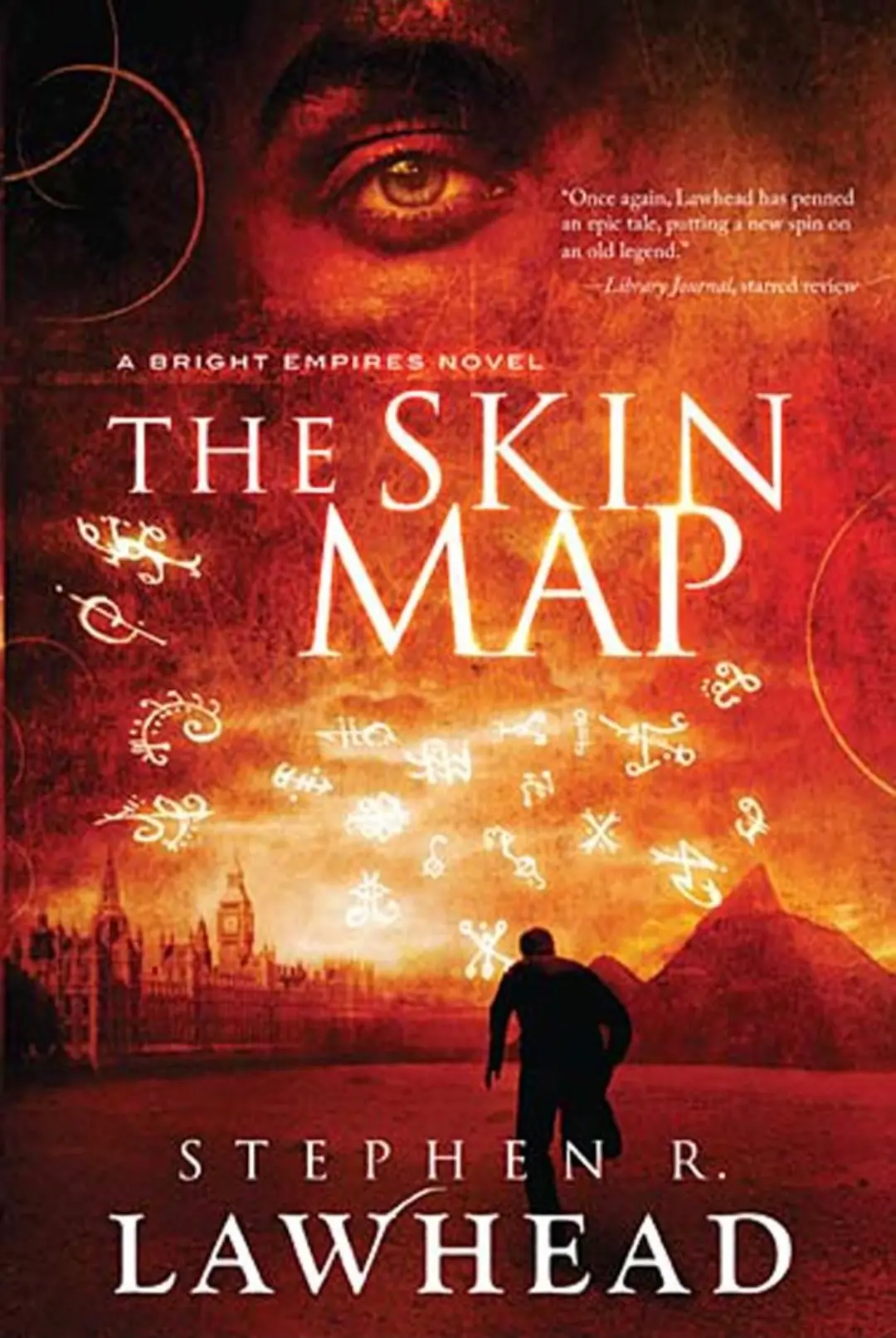

- Title: The Skin Map
- Author: Stephen R. Lawhead
- Genre/Subject: Speculative historical fiction
- Publisher: Thomas Nelson
- Publication Date: 2010
- Start date: 4/23/26
- Finish date: 5/2/26
Well, this was not good. Not good at all. I’m not going to pan it and trash it, the author writes fairly well but this book was all over the (skin) map and was a real slog to get through. Remember, I’ve been through Life of Johnson and Decline and Fall so when I say something is a slog it has to be exceptionally sloggish.
From the promotional material: The Skin Map, the first installment in Stephen R. Lawhead’s Bright Empires pentatouch, serves as an ambitious foray into the intersection of historical fiction, science fiction, and ley line theory. The narrative departs from Lawhead’s traditional Celtic or Arthurian roots, opting instead for a multi-era “quest” structure that spans various dimensions and centuries.
If you say so.
The story begins in contemporary London but rapidly expands as the protagonist, Kit Livingstone, is thrust into the discovery of “ley travel”—a method of traversing time and space via specific geographic focal points. The central object of the quest is the eponymous Skin Map, a legendary parchment supposedly tattooed onto the skin of a 17th-century explorer, which contains the secrets to navigating the Omniverse via the Ley Lines.
So what are these ley lines then? Think of soap bubbles in water, where they touch you can connect to other bubbles, but you never know which bubbles connect to which other ones and where you will cross into the connecting bubbles. So with the ley lines, only you also can’t predict the “when” of the connections. So you can go from 21st century London to 17th century London, or to colonial Africa, or ancient Babylon, or to 21st century Argentina, you just never know and can’t do anything to control it.
It’s a nice conceit, but it quickly devolves into situations that go way past any reasonable suspension of disbelief. For example, the protagonist ends up in 17th century London in the company of his eccentric Great-great-Grandfather and his natural scientist buddy. Who happens to be super smart, a peer of the realm and has all the knowledge, books, and buckets of money to aid in the quest for the map. Naturally nobody seems to notice our hero’s clothes, hair, modern speech, Adidas trainers. There are of course, bad guys who are also after the much coveted skin map and they seem to turn up at every opportunity to threaten the heroes. I thought Kit was a goner until… a female whatever the Chinese equivalent of a ninja warrior is shows up and kicks ass in her silk slippers.
Then, the scene shifts to the protagonist’s girlfriend, one Wilhelmina Klug who missed London and hit 17th century Prague instead. No one notices her short hair, denim, the fact that she picks up 17th century Czech language without the Babel app, and her independent and sassy attitude. What does one do in this situation? Well our heroine decides to team up with a fat German dude named Etzel and start a bakery. I mean who wouldn’t? But wait, there’s more…
The bad guy mastermind ends up in Indiana Jones Cairo, complete with man-with-fez and chase scenes through crowded alleys and dark lanes filled with blackguards and sinister men in turbans and linen pajamas. Then back to 19th century Oxford University for some reason or other.
And then there’s the food. Every single time any character, good or bad, gets peckish the food is described in Proustian detail. Made me hungry every chapter. Will no one rid me of this meddlesome banquet?
The novel maintains a brisk tempo due to frequent shifts in setting, though this leads to a rambling and fragmented reading experience. Trying to keep track of who is where and when is a big task in itself and just leads to more confusion. The thing this whole novel reminded me of is this. Back in the day people played Dungeons and Dragons but everyone knew one person who tried to cross the streams with Star Frontiers. So you go on a dungeon crawl but you fight aliens with lasers. That sort of thing never worked for me then, and doesn’t work for me now.
Critics often note that while The Skin Map is heavy on exposition regarding the mechanics of the Omniverse, it functions effectively as a “setup” novel. The first part of a trilogy entry portal. The complexity of the multiple timelines requires significant attention from the reader, which it turned out I wasn’t equipped with. The work represents a pivot toward “speculative historical fiction,” and in the end it satisfies neither.
Lawhead treats time and space as permeable, allowing characters to jump between the 17th-century Prague of the Holy Roman Empire, the stone age, and the 19th-century British Raj, Cairo, and so on ad infinitum. No, make that ad nauseum.
Much of the tension arises from the race between Kit’s grandfather, Cosimo, and the antagonist, Lord Burleigh, both of whom seek the map for divergent reasons—enlightenment versus absolute control and this is actually rather well done all things considered.
My Conclusions
This wasn’t a dog, but it fell short in so many areas that it was not a good reading experience for me. Maybe this will be the book and series starter that people will love and devote fan-cons to, but I doubt it. If you want, give it a go, but I can’t recommend it.
This book made me want to: Get through it and move on to something else.
Overall rating: 
Readability:
Plot:
Other: Accurate descriptions of pre-electric tattooing. Nasty business.