
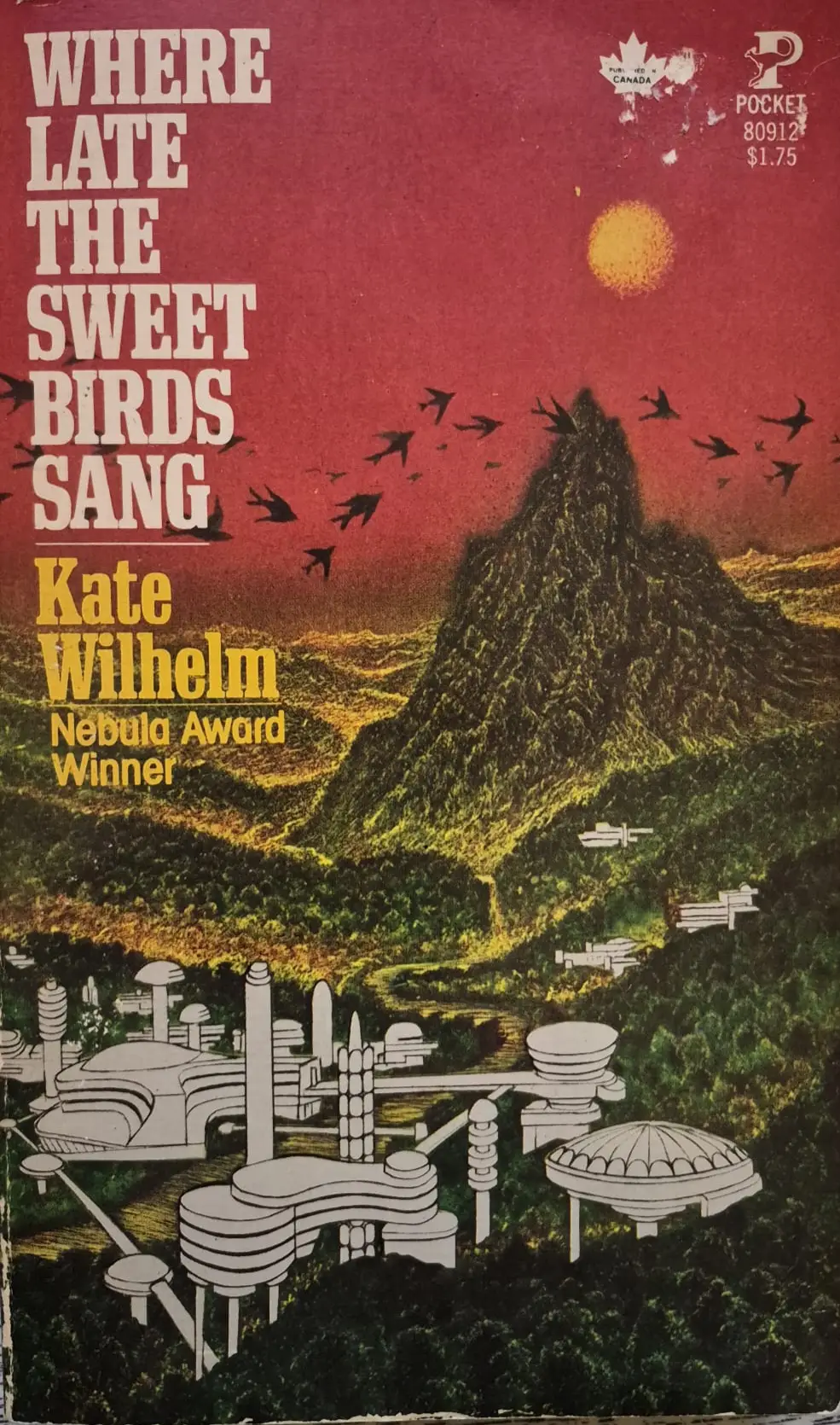

- Title: Where Late the Sweet Birds Sang
- Author: Kate Wilhelm
- Genre/Subject: Speculative fiction
- Publisher: Pocket Books
- Publication Date: 1976
- Start date: 5/6/26
- Finish date: 5/10/26
Overview
This is a masterpiece. You are likely thinking, “Neilos says things like that in a lot of his reviews.” That’s true, but rather than saying, “no this time I really mean it” I will say that the reason is I read a lot of great books. Not all of them, what fun would that be for you readers of this blog? But this, is a genuine classic with an extraordinary resume. So here we go, from the beginning.
First published in 1976, Kate Wilhelm’s novel Where Late the Sweet Birds Sang, stands as a cornerstone of speculative fiction, winning the Hugo, Locus, and Jupiter awards. A triple award performance like that is the equivalent of winning the Triple Crown in horse racing, meaning it does happen, but it’s a rare and extraordinary achievement. The novel is a post-apocalyptic narrative that explores the ethical and psychological consequences of human cloning as a survival strategy against extinction. The title, derived from Shakespeare’s Sonnet 73, sets a melancholic tone for a story focused on the fading of individual human identity.
Plot Structure and Narrative Arc
The novel is divided into three distinct sections, each representing a different stage in the evolution of the Sumner family and their descendants.
Part One: The Preservation: Faced with global environmental collapse and widespread infertility, the wealthy Sumner family establishes a secluded compound in Virginia. They turn to cloning to ensure the survival of their lineage. This segment functions as a survivalist thriller, detailing the transition from natural birth to laboratory-reproduction.
Part Two: The Community: Decades later, the original humans are dead. The society is composed entirely of clones who live in “brothers” and “sisters” groups. These clones possess a form of low-level telepathy or extreme empathetic bonding, creating a collective consciousness. The narrative focuses on Molly, a clone who displays a “defect”—the desire for individuality and artistic expression.
Part Three: The Outsider: The final section follows Molly’s son, Mark, who is born naturally and lacks the telepathic bond. As the cloning technology begins to fail due to genetic drift and a lack of innovation, Mark becomes a pariah. He eventually represents the resurgence of the individual spirit and the necessity of biological diversity for long-term survival.
The novel is divided into three parts and basically, sorta, in my opinion three main themes.
- The Conflict Between Individual and Collective
Wilhelm examines the trade-offs of a hive-mind existence. While the clones live in perfect harmony and lack the “loneliness” of the old world, they also lack creativity, curiosity, and the ability to adapt to new problems. The book posits that true humanity requires the isolation of the individual “I” to foster original thought. - Environmental and Biological Hubris (sound familiar?)
The collapse of the world is portrayed as a result of human interference with nature. The Sumners’ attempt to “solve” extinction via cloning is shown as a secondary form of hubris. The clones view the natural world with fear and detachment, treating it as a resource rather than an ecosystem to which they belong. - The Role of Art and Subjectivity
In the novel, art is the ultimate marker of the individual soul. When the collective cannot understand or value art, or even a unique perspective, it signals their eventual stagnation and decline.
The novel is set in the USA in the Shenandoah valley, like the same geography and based on the actual place. Not a Venusian plain or some other planet’s jungle as was so popular with Wilhelm’s contemporaries. Solid American farmland, slow flowing rivers and ancient oak trees in the hills surrounding the Sumner farm. The Sumners are wealthy, very wealthy and also very well educated. So when it becomes impossible to ignore that the climate and political situation is on a deadend road to armageddon they make a plan and put it into action. Using their enormous wealth the Sumner family made their isolated farm and surrounding property into a post-apocalyptic citadel and stocked it up. And I mean stocked it up, with everything they could think of that would provide everything their descendants needed. Everything needed to raise foods, educate their children, and laboratories full of scientific research equipment to ensure their future survival.
But the best laid plans… Within a few generations the family begins to suffer from sterility and they decide that cloning offers the only solution to their continued survival. It surprised me that the science in 1976 when it was written was so accurate regarding the sterility of clones. At first cloning works, but then after a few generations you have the sterility problem. Every so often a clone is born with individuality and the ability to sexually reproduce. The women with this ability become breeders, like the Handmaids, they live apart and get bred with drugs to suppress their individuality. As the saying now is, individuality is a bug rather then a feature. One of these women, Molly, escapes and gives birth to a son, Mark who is also blessed with individuality but being a male can’t be used as a breeder.
What to do about Mark? The clone leaders and scientists need him. NEED him. But not for his genes. Mark can do a lot of things that the clones can never do, like be alone in woods, like painting and sculpting, like go on a canoe voyage of exploration outside the confines of the farm and surrounds. This is a key plot point because the citadel is running out of things. Needful things like lab equipment, chemicals, spare parts for everything from toasters to test tubes. And these things can only be found in the cities, but first they need to find the cities, if there are any left. The cities sequences really spooked me, hit me at an emotional level. With the current state of the world the threat of something similar is all too real. 1976 to 2026 is 50 years and this future is increasingly probable. That’s a shame but that’s where we’re at.
In the third and final section of the novel the narrative thread focuses on Mark training the clones to do future salvage missions. This proves nearly impossible as the clones can’t handle camping, forests, the river beyond 200 meters of the last farm field. This can and was overcome, to an extent but then they discover something really bad. The clones can learn anything and learn it precisely and rapidly. Build a fire, make a raft, chop down a tree, done done and done to perfection. But the scientists and Mark discover that they can’t create, they can do by rote and that’s it. So say you’re paddling down the Shenandoah and there’s a stretch of rapids. You take the canoe out, portage around them and get back on the river. To the clones this is an unsolveable problem and they would stay stuck on the shore until the cold death of the sun. I won’t spoil the ending for you, but you readers are not clones (except Brant, who was cloned from an ancient homosexual) and you’ll likely make up some endings until you finally get and read this amazing novel.
Where Late the Sweet Birds Sang remains a vital work because it moved beyond the “adventure” tropes of 1950s and 60s sci-fi. It introduced a sophisticated, feminist-inflected critique of technology and communal living. It serves as a precursor to modern biological dystopias, emphasizing that survival is not merely a matter of keeping the species alive, but of keeping the human spirit intact. Keeping our minds and spirit as individuals is more important than ever with the black/white partisan politics that is our daily experience in 2026, and this novel reminded and affirmed this for me. So in closing I can only say:
This was a masterpiece.
This book made me want to: Go for a walk in the woods.
Overall rating: 
Readability:
Plot:
Other: Brevity. 205 pages was all that was needed to craft a masterpiece.