
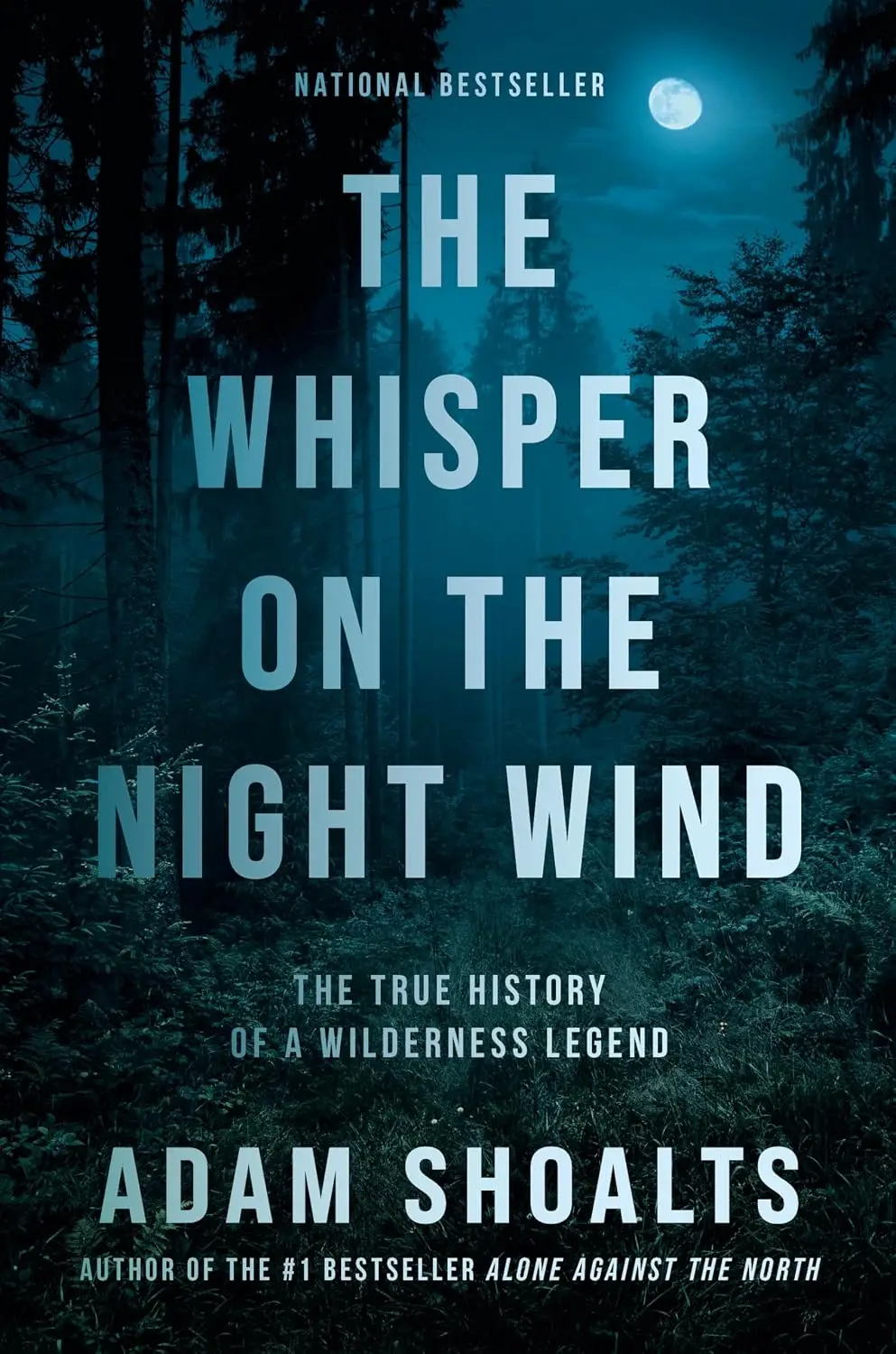

- Title: The Whisper on the Night Wind
- Author: Adam Shoalts
- Genre/Subject: Canadian literature
- Publisher: Penguin
- Publication Date: 2021
- Start date: 7/7/2026
- Finish date: 7/9/2026
This was a proper Canadian wilderness adventure tale, with a historical mystery thrown in like extra curds on poutine.
The Whisper on the Night Wind by our very own Canadian explorer and author Adam Shoalts investigates a century-old mystery in the remote interior of Labrador. The narrative centers on the historical accounts from the early 1900s regarding the “Traverspine Monster”—a strange, unknown creature that terrified settlers, fur trappers, and Indigenous residents around the isolated hamlet of Traverspine. Shoalts, accompanied by companion Zach Junkin, undertakes a grueling expedition through the Mealy Mountains wilderness to trace historical clue trails, examine archival records, and attempt to resolve the mystery behind the legend. Normally I don’t like modern explorer dudes, half the time they don’t know what they’re doing and either die or need a vastly expensive rescue to haul their stupid asses out of the wilderness. However, Adam Shoalts is the real deal and not simply as an explorer, he also holds a doctorate in history and knows his stuff.
* Historical Context: In the early 20th century, reports emerged from Traverspine, a tiny village in the Labrador wilderness, detailing large footprint tracks, missing sled dogs, unsettling night vocalizations, and sightings of a large, unidentified bipedal or quadrupedal animal. The accounts were recorded by credible observers, including physicians and wildlife biologists. Sounds like a good campfire story, but there were enough credible observers and written accounts to make this worth investigating.
* The Expedition: Shoalts and Junkin navigate pathless forests, bogs, and mountain terrain by canoe and on foot. Their route retraces old fur-trade trails and historical landmark references in search of physical evidence and long-abandoned settlement ruins. And unlike a lot of Nat Geo type adventure stories Shoalts doesn’t shy away from the nasty details and hardships of busting bush in Labrador’s wilderness. For those of you not Canadian or Canadians not familiar with Labrador’s wilderness: Labrador is nothing but wilderness. Flies, mosquitoes, muskeg (that’s Canadian for mosquito infested bog), impenetrable forests, and rapids that can destroy a canoe faster than I can demolish a footlong hot dog (that’s fast).
* The Resolution: Through a combination of archival research, field analysis, and ecological knowledge, Shoalts provides a grounded, scientific explanation that demystifies the phenomenon while respecting the regional folklore.
Strengths
* Meticulous Historical Research: Shoalts effectively integrates primary source material—such as diaries, period letters, and official logs—giving the mystery genuine weight and historical grounding.
* Evocative Atmosphere: The book excels at capturing the eerie, isolation-heavy atmosphere of the Labrador wilderness, blending suspense with wilderness travelogue.
* Accessible Exposition: The balance between rigorous geographical detail and narrative storytelling makes the text engaging for both outdoor enthusiasts and mystery readers.
Weaknesses
* Readers accustomed to supernatural thrillers say they find the logical, realistic resolution less dramatic than the initial lore suggests. In other words, there’s no sasquatch and a lot of people want a monster in their spooky story.
* As with several of Shoalts’s wilderness memoirs, the emphasis on physical hardship and extreme conditions can occasionally feel repetitive or exaggerated to readers not familiar with northern travel.
* A big problem I found was the lack of direction for the expedition itself. Shoalts threw it together in a few days and texted his buddy Zach to see if he wanted a quick adventure. Okay, but it was September and that’s late, no, foolishly late in the sub-arctic to set out on a journey. And after they found the remains of Traverspine they seemed to have no real plan other than to get up into the mountains and have a snoop around, maybe check out some caves. Hardship for hardship’s sake doesn’t make a good strategy in my opinion, so bouldering their way upstream through wild rapids seemed a bit careless and dangerous to me. Also they frequently complained of dehydration, which is a real killer when you’re way out in the bush.
Conclusions
The Whisper on the Night Wind succeeds as an atmospheric blend of Canadian history, cryptozoological investigation, and real-world exploration. It demystifies local folklore without diminishing the awe and vastness of the northern wilderness. But it was like a trick-shot in pool, you’re the man if you make it but look like a dope if you don’t. So it was great that they did this and made it back unscathed, but had it gone sideways in any of a thousand different ways this would not be an adventure story but a major disaster for everyone, including anyone having to rescue them. If they could rescue them.
I really enjoyed reading this and I think it was well written and honest throughout, with the caveats I noted. I do want to read more of Shoalts and his adventures, but I want people reading this to remember this is not something that 99.9% of humans can do and it should be left to professionals like Shoalts. All in all a really good book and I hope that Shoalts keeps exploring and keeps writing.
This book made me want to: Stay out of Labrador
Overall rating: 
Readability:
Plot:
Other: Repeated use of the sentence, “Did you hear something?”