
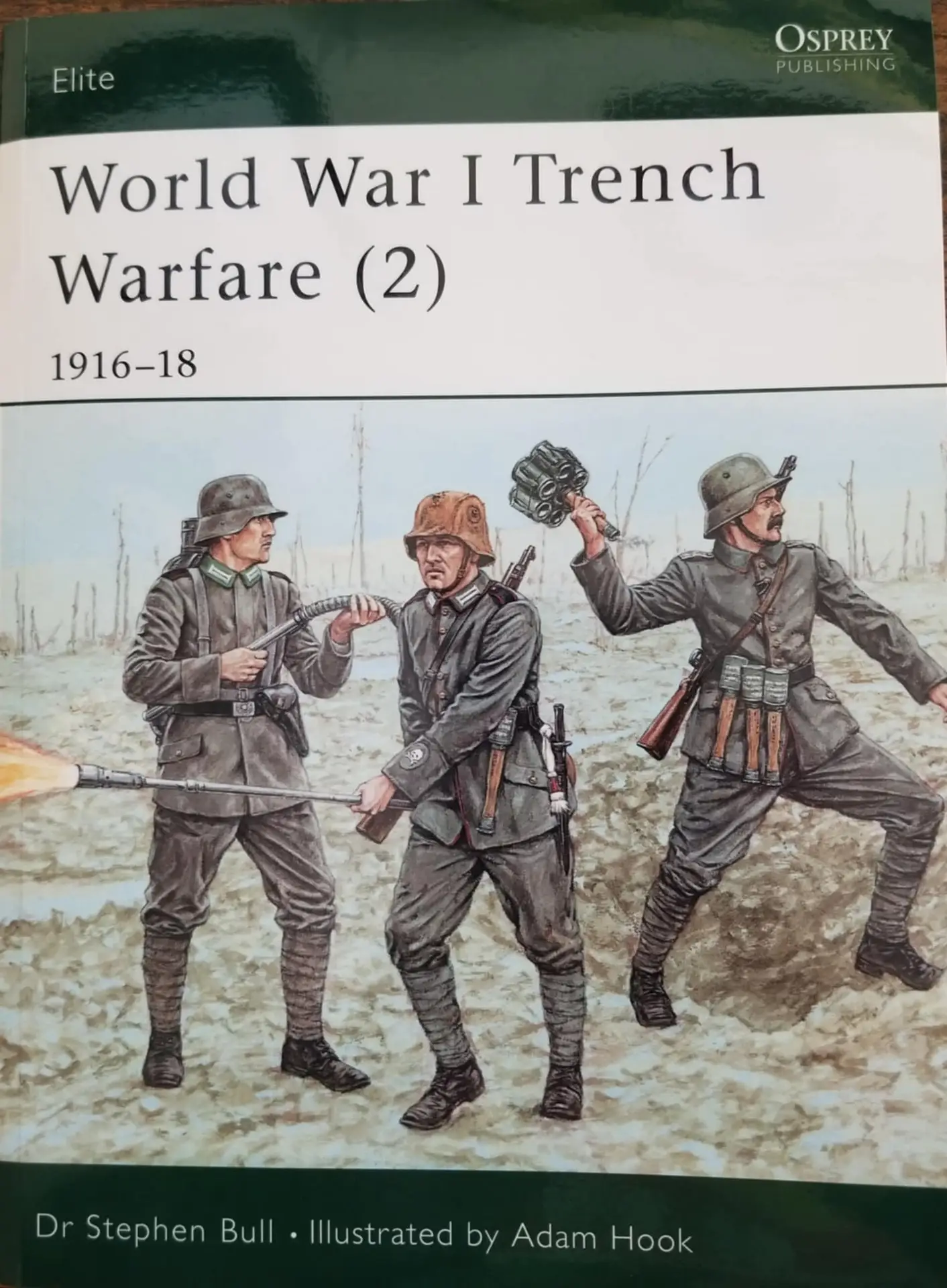

- Title: World War I Trench Warfare Volume 2
- Author: Osprey Books
- Genre/Subject: WWI History
- Publisher: Osprey Books
- Publication Date: 2002
- Start date: 5/30/25
- Finish date: 6/16/25
Review:
Neilos reading a book on World War One history? Shocking! Okay not really, and despite all the books I read on this subject I always learn something new, and this book was no exception.
For those that don’t know, Osprey books are the gold standard in military reference books. They have hundreds of volumes on everything from Afghanistan to Zulu warriors, all researched extensively by experts in each special subject. And all are beautifully illustrated with photos, blueprints, full colour artwork and diagrams throughout.
As this is volume two the narrative begins in 1916 with the Allied attempt to break the stalemate of Trench Warfare, with disastrously costly results in terms of men, material and morale. First of all the Allies tried a series of “big pushes” to accomplish a breakthrough and the Germans responded by developing schemes of defence in depth. None of this had any real effect until technology and innovation began to move ahead and change the way the war was fought.
The tank is a good example of an innovation that began as a curiosity and ended up changing the way all future wars were conducted. The tank was introduced in 1915 but was an accident-prone obscurity, but as the war progressed so did the design and operation of the tank as an offensive weapon. It was not until 1918 that the German High Command introduced their own version of a tank, the singular and ill-fated A7V. By the second war the German High Command had tanks pretty much figured out but this first foray was almost completely ineffective.
Or another example is the rise in the strategic use of aviation to wage war. When the war began in 1914 the only airplanes were still called flying machines and were volunteered and piloted by wealthy aviation enthusiasts. They were used almost exclusively for reconnaissance but as the war progressed the airplane would play an increasingly important role in offensive operations for both the allied and axis armies.
This is an excellent resource book for making my modeling and dioramas more realistic and accurate. I looked at my first big trench diorama and now I see it as over simplified and inaccurate, but still capturing the spirit of the scene. With resource materials like this in my workshop I guarantee that my next effort will be an improvement. That being said it’s not really a page-turner and I don’t recommend it unless you need it like I do for a specific reason.
This was an excellent book as I have been accustomed to from Osprey Publications and while I don’t recommend it at all to the general reader or even those looking to learn more about the Great War I highly recommend it to those that specialize in this conflict as I do.
This book made me want to: Continue my policy of never modeling dead soldiers in any of my dioramas.
Overall rating: 
Readability:
Plot:
Other: Explaining the war without seeming too enthusiastic about it, that happens too often and this book successfully avoided that trap.